
China Travel: Liuzhou's Smelly Noodle Is an 81 Billion Yuan Industry
A bowl costs 8 to 15 yuan, the smell comes from fermented bamboo shoots, and the city exports 60 million yuan of it a year. Here is how to eat it properly.
Key takeaway
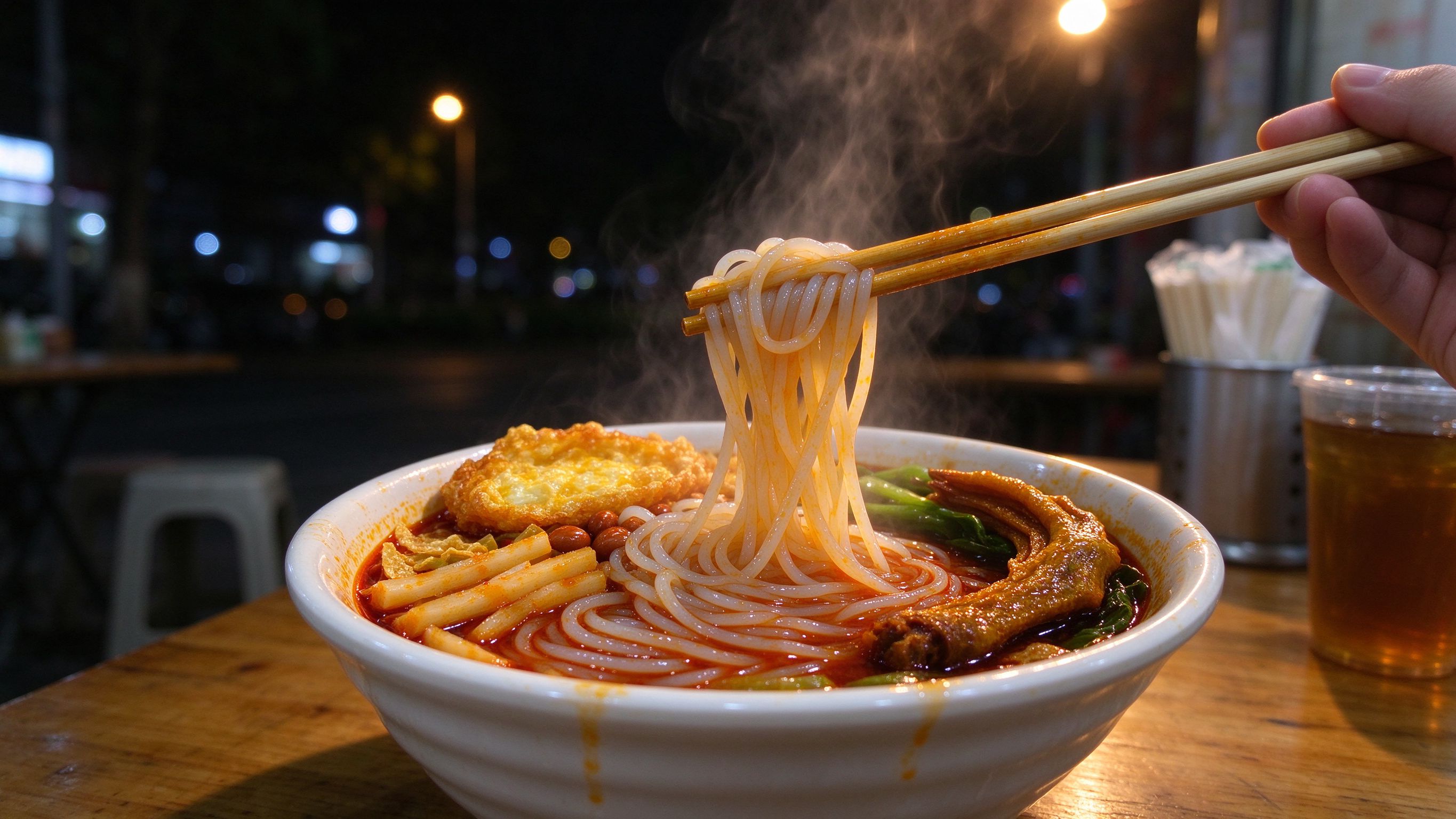
Luosifen is Liuzhou's rice-noodle soup in river-snail and pork-bone broth, topped with fermented bamboo shoots (酸笋), fried tofu skin, peanuts and chili oil; the smell comes from the bamboo shoots. A local bowl costs 8-15 yuan, about 20 with a fried egg or duck foot, versus 30-40 in Shanghai or Beijing. Order 汤粉 or 干捞, add toppings by pointing, and eat it at a street shop rather than the packaged version.
Full report
The smell arrives before the bowl
At a Liuzhou street stall the first thing that reaches you is not chili or steam. It is a sour, fermented, faintly drain-like smell that makes first-timers check the ground. It comes from 酸笋, bamboo shoots fermented for months, and it is the entire point of 螺蛳粉: luosifen, the rice-noodle soup that has become China's most argued-about dish.
Locals do not flinch. They lean over the bowl and slurp. By the third spoon the smell stops registering and the broth takes over: river snail, pork bone, chili oil, sour bamboo, and fried tofu skin floating on top.
What is actually in the bowl
Round, slightly translucent rice noodles. A broth built on river snails and pork bones. Then the toppings that define it: pickled bamboo shoots, fried peanuts, wood ear, fried tofu skin, a few greens, chili oil poured last. The snail flavors the soup; it is not the star.
Order 汤粉 (in broth) or 干捞 (drained, sauce instead of soup). Both are proper. If you are unsure about the smell, start with 干捞. 炒螺蛳粉 is the third variant, drier and chewier.
The price is the shock, not the smell
In Liuzhou a plain bowl runs 8 to 15 yuan. Add a fried egg or a braised duck foot and you are still around 20, under three US dollars for a full dinner. 干捞 is about 12, 炒 about 17. The same bowl in Shanghai or Beijing costs 30 to 40. Here it is what people eat on a lunch break.
The trip costs more than the food. Guangzhou South to Liuzhou is 3 hours 20 minutes to 4 hours by high-speed rail, second class around 239.5 yuan. From Shenzhen Pingshan it is just under five hours. Both get you in before dinner.
A city that turned a smell into an industry
This is the part outsiders miss. Liuzhou is a Guangxi industrial city of steel and cars, and it has turned a local breakfast into a national supply chain. Full-chain sales of luosifen reached 81.31 billion yuan in 2025, with prepackaged bowls alone at 16.3 billion. Exports were 90.03 million yuan in 2025, sold into more than 30 countries. In the first seven months of 2026 exports hit 53.88 million yuan, up 13.6 percent year on year; by August the running total was 60.03 million, up 6.7 percent.
In 2026 the city also secured a dedicated export commodity code for prepackaged luosifen, and a separate export rebate rate took effect on 1 January. In plain terms, the smell now has customs paperwork.
That matters for travelers because the packaged version is everywhere, in supermarkets and convenience stores, and it is not the same experience. A packet costs 10 to 20 yuan and tastes decent. The fresh bowl at a street shop has a texture no packet reproduces. If you came for the food, eat it in Liuzhou.
How to order without Chinese
Point at the noodle pot and say 一碗螺蛳粉 (one bowl). If chili worries you, 微辣 (mild). If the sour bamboo is too much, 少酸 (less sour). Add 炸蛋 (fried egg), 鸭脚 (duck foot) or 腐竹 (tofu skin) by holding up a finger. WeChat Pay and Alipay work; smaller shops still take cash.
Two practical notes. Service is fast and so is eating; nobody lingers over a bowl. And the smell stays on your clothes, so sit outside if the shop has tables there, and do not wear the shirt you plan to photograph in.
Where to put it in a Guangxi trip
Most itineraries skip Liuzhou and run Guilin to Yangshuo. Liuzhou is the detour that makes the food side of the trip real: one night, two bowls at two different shops, the industrial museum if it rains, then south or back to Guangzhou.
The trade-off is simple. For scenery, Guangxi has better. For the one meal you will still be describing six months later, this is it.
For ordering, payment and what to skip at street stalls, our China street food guide covers the rest.
What to do next
Build one night in Liuzhou into a Guangxi route: arrive on an afternoon high-speed train from Guangzhou or Shenzhen, eat one 干捞 bowl and one 汤粉 bowl at two different shops, and continue to Guilin or Yangshuo the next day.
What may vary
Street prices and rail schedules change; some shops close in the afternoon and reopen for the evening rush. Confirm train times and opening hours before traveling.