
Jingdezhen Pottery: Real First-Time Travelers' Stories From China's Porcelain Capital
Jingdezhen pottery classes give first-time visitors a rare, hands-on connection to China's UNESCO-listed porcelain heritage — expect to fail at the wheel, learn, and take home a handmade souvenir that no shop can sell you.
Quick answer
Jingdezhen pottery classes give first-time visitors a rare, hands-on connection to China's UNESCO-listed porcelain heritage — expect to fail at the wheel, learn, and take home a handmade souvenir that no shop can sell you.
Detailed answer
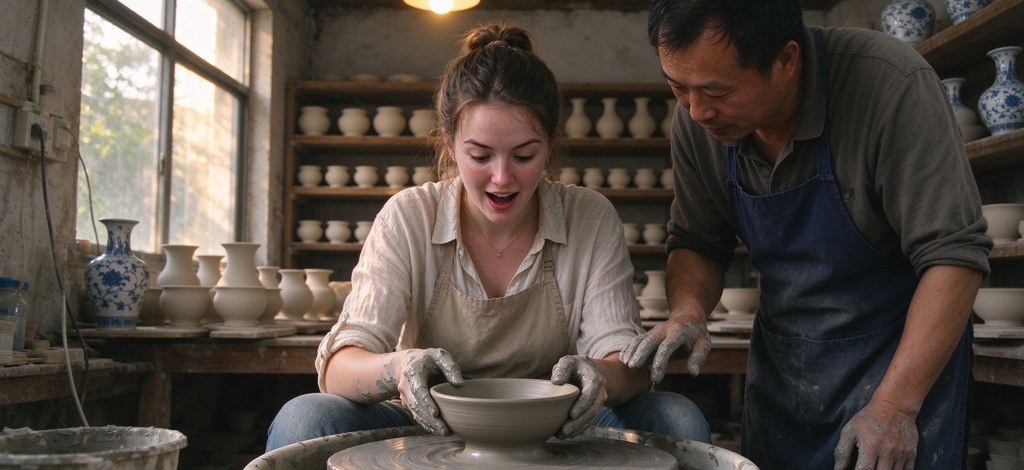
There is a moment, about forty minutes into your first pottery class in Jingdezhen, when the clay wins.
It doesn't collapse dramatically. It just slumps sideways, a wet grey lump on the wheel, and you sit there with muddy forearms thinking: this city has been doing this for a thousand years, and I cannot keep a bowl upright for ten seconds.
That moment is the whole point. Every traveler who tells a good Jingdezhen story has one.
The traveler who fought the clay for an hour
Damian, a tourist from Poland, spent over an hour wrestling a lump of clay at a throwing class here. People's Daily reported his session in August: the wheel spun, his hands worked, and the clay simply refused to become what he wanted.
His wife Zane had a smoother go. She worked through the whole sequence — wedging the clay, throwing it, then trimming the piece on the wheel — and walked out with a bowl she had made, plus a few small pieces fired and finished.
Same studio, same clay, two completely different days. That's not a failure of teaching. That's the experience.
What it actually feels like
Most classes run one to three hours. You sit at a wheel, an instructor centers the clay for you, and then you're on your own with a spinning lump, water, and your own two hands.
Costs vary by studio. Trip.com travelers report wheel-throwing sessions around 50–80 RMB per person at workshops in Sanbao, and a two-hour beginner class at some studios runs 150–300 RMB including materials, firing, and shipping one piece home. Booking through Trip.com or the studio directly both work; the studios are used to foreigners, and the instructors switch to simple English or draw diagrams when you're stuck.
The first bowl usually looks rough. That's normal. Nobody in the room is pretending otherwise.
Why travelers keep talking about it
Arjun Gurung, a tourist from Nepal, sat at the wheel inside Jingdezhen's Ancient Kiln and Folk Customs Museum with a group from home. Under local artisans' guidance, they worked a lump of clay into shape. His takeaway, reported by China Daily, is the line that keeps coming back:
"It was only after experiencing the process of making porcelain myself that I truly understood more about Chinese culture and history."
That's the quiet part nobody puts on the poster. A thousand years of ceramic history sounds like a museum exhibit until you've got wet clay under your nails and a patient teacher watching you fail, try again, and get a little closer.
The souvenir problem is solved
Jingdezhen shops are full of beautiful porcelain — you'll buy something, everyone does. But the piece you made, fired and mailed to your home address, is different. It's crooked, probably. It has your fingerprint in it.
Workshops will glaze, fire, and ship your work abroad for a fee — most studios quote international shipping at booking. When the package finally lands, you'll unpack a slightly misshapen bowl and remember exactly which part of the afternoon it came from.
Practical notes before you go
- Where: Sanbao International Ceramic Village is the most common choice, about 20 minutes from the city center. Taoxichuan Creative Market also runs workshops.
- When: Trip.com travelers recommend starting early and treating the workshop as the morning anchor of the day. Studios take walk-ins at most hours.
- What to wear: something you don't mind getting muddy. Aprons are usually provided; use them.
- Language: instructors are used to non-Chinese speakers. Diagrams, gestures, and a phone translator get you through.
- The honest part: your first piece may crack in the kiln. Studios fire hundreds of pieces; a failure rate is normal. The second piece usually survives.
Jingdezhen's handicraft porcelain industry sites joined the UNESCO World Heritage List in July 2026, the first ceramics site on the list. The kilns are old. The class is new. Both are worth the trip.
If you've tried a craft class on your China trip — pottery, tea, hanfu, calligraphy — what did you make, and did you keep it? The good stories are in the comments.
What to do next
Book a 2-hour wheel-throwing class at Sanbao International Ceramic Village (about 20 min from the city center) or Taoxichuan Creative Market; most studios accept walk-ins, glaze, fire, and ship your piece internationally.
How to do it
Choose a studio: Sanbao International Ceramic Village is the most common choice; Taoxichuan Creative Market also runs workshops.
Start early: travelers recommend treating the workshop as the morning anchor of the day.
Wear something you don't mind getting muddy — aprons are usually provided.
Let the instructor center the clay for you, then practice throwing; expect your first bowl to look rough.
Optional: pay for firing and international shipping so your piece arrives home (usually quoted at booking).
Watch for
Expecting your first piece to look perfect — it won't, and that's normal.
Forgetting to ask about international shipping cost at booking.
Wearing clothes you mind getting muddy; clay gets everywhere.
Panicking when the clay slumps — even experienced travelers fight the wheel for the first hour.
What may vary
Prices vary by studio (wheel-throwing roughly 50–80 RMB in Sanbao; beginner classes 150–300 RMB including firing and shipping one piece). Your piece may crack in the kiln — a normal failure rate. Instructors speak limited English but use diagrams and gestures.