
18 Days to APEC in Shenzhen: 57 Countries Now Get 240-Hour Visa-Free Transit to China — Here's the 10-Day Playbook
APEC 2026 lands in Shenzhen on November 14, and the timing could not be better for travelers: the 240-hour visa-free transit policy now covers 57 countries, letting eligible visitors stay up to 10 days across 24 provinces. Shenzhen airport even runs free city tours for transit passengers. Here is the practical playbook before the city becomes the center of the Asia-Pacific conversation.
Key takeaway
APEC 2026 opens in Shenzhen on November 14 (18 days away), and the 240-hour visa-free transit policy now covers 57 countries — including the US, UK, France, Germany, Japan, Australia and, since August 20, 2026, Kyrgyzstan and Vietnam. Eligible travelers with an onward international ticket can enter from any of 65 ports across 24 provincial-level regions and stay up to 10 days. Shenzhen Bao'an airport also offers free city tours for transit passengers with a layover over six hours.
Full report
The Countdown Is On — and the Door Just Got Wider
APEC 2026 opens in Shenzhen on November 14, with 18 days to go. For travelers, the bigger story is what changed before the flags went up: China's 240-hour visa-free transit policy now applies to 57 countries, after the National Immigration Administration (NIA) added Kyrgyzstan and Vietnam on August 20, 2026.
In plain terms: citizens of the 57 covered countries holding an ordinary passport plus a confirmed onward international ticket can enter China visa-free from any of 65 open ports across 24 provincial-level regions, and stay up to 10 days within the designated area. That is the practical answer to the question most first-time visitors actually ask: how much China can I see without a visa?
What the 57-Country Transit Policy Actually Allows
- Who qualifies: passport holders of the 57 countries (including the US, UK, Russia, France, Germany, Japan, Australia, Canada, and now Kyrgyzstan and Vietnam).
- The one rule that matters: you must hold a passport valid for the trip, plus a booked onward international air, ship, or rail ticket to a third country or region.
- The 10-day window: you can stay and travel within the designated region for up to 10 days — enough for a Shenzhen-Guangzhou loop, a Greater Bay Area week, or a Beijing flight connection with a proper itinerary inside.
- 65 ports, 24 provinces: the policy is not a single-city perk. Entry is available at any of 65 open ports, which matters if your flight lands in one city and you want to leave from another.
The Shenzhen Angle: Free City Tours for Transit Passengers
Shenzhen Bao'an International Airport has been running free city tours for international and regional transit passengers with a layover of more than six hours — including travelers connecting international-to-domestic, domestic-to-international, or international-to-international. The service is open to passengers who hold a valid visa or qualify under the 240-hour visa-free transit policy, and registration is done by scanning the QR code on airport leaflets.
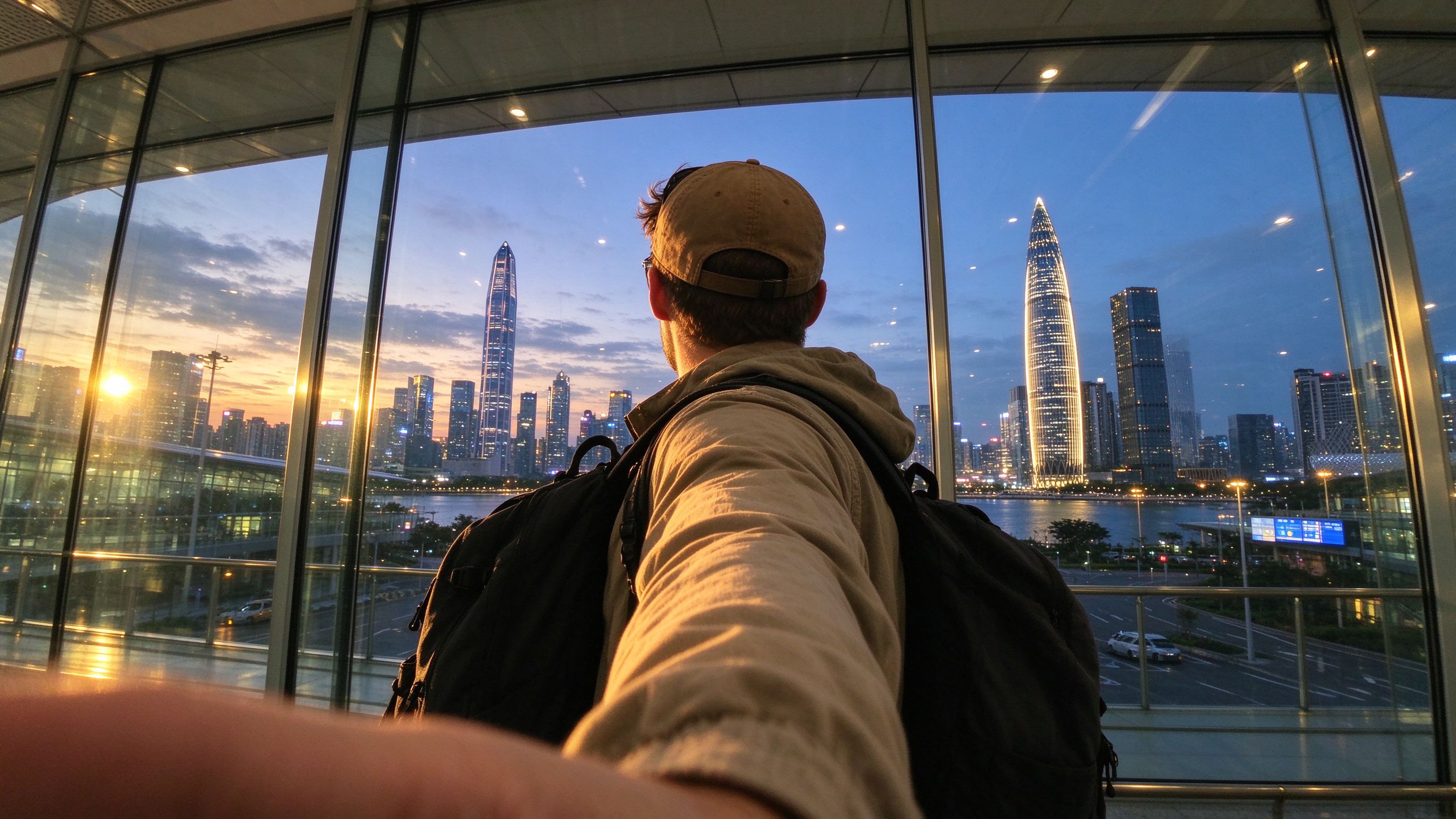
It is a small detail with a big effect: a long layover in Shenzhen is no longer an airport-waiting problem. It is a same-day taste of the city — a waterfront skyline, a market meal, a metro ride — with no visa application in between.
Why Shenzhen, Why Now
Shenzhen is hosting APEC 2026 as the tech-forward face of the Asia-Pacific: low-altitude economy demos, the AI conversations that made the agenda this year, Huaqiangbei's electronics lanes, and a 40-year arc from fishing village to innovation hub. For a traveler, the same week doubles as a business trip and a travel experience — which is exactly what the transit policy was built for.
If you are combining the meetings circuit with a trip, keep the Canton Fair in view too: it runs in nearby Guangzhou through the autumn, and the two hubs sit an hour apart by high-speed rail. One visa-free window can cover both.
Your 10-Day Playbook
- Day 1–3: Land in Shenzhen, take the free airport city tour or the metro straight downtown. Do Huaqiangbei, the Shenzhen Bay waterfront, and one evening market.
- Day 3–5: High-speed rail to Guangzhou. Morning dim sum, the Canton Fair if it overlaps your dates, and the old-city lanes at night.
- Day 5–8: Optional leg north — Zhuhai or a Greater Bay Area stop — or stay put and go deeper on Shenzhen's design districts and tech campuses.
- Day 8–10: Slow down, shop, and head back through Shenzhen Bao'an for the onward flight.
The Fine Print
Hours, port lists, and eligibility details do change. The 57-country list and the port-by-port rules are published by the NIA — check the official page for your nationality and travel dates before booking. The 240-hour window counts from the moment you enter, and the onward ticket is non-negotiable. If your passport is not on the list, the separate unilateral visa-free arrangements (extended through the end of 2026 for several countries) may still cover you.
The Bottom Line
Eighteen days out, Shenzhen is dressing up for APEC — and the visa policy is already the friendliest it has ever been for the 57 eligible countries. The planning math is simple now: one onward ticket, ten days, a region that runs from Shenzhen's skyline to Guangzhou's teahouses. The hard part is no longer the visa; it is choosing what to do with the week.
For the full APEC Shenzhen prep guide, including the 240-hour transit rules and Greater Bay Area itineraries, visit our APEC Shenzhen hub. Travelers combining the trip with the trade-show circuit can check the Canton Fair guide in parallel.
What to do next
Check your nationality against the NIA 57-country list and the 65-port map before booking. Book a confirmed onward ticket out of China first — it is the one hard requirement. Then plan a Shenzhen-Guangzhou Greater Bay Area week: airport city tour on arrival, Huaqiangbei and the Bay waterfront in the first days, dim sum and the Canton Fair (if dates overlap) in Guangzhou, and a high-speed rail return to Shenzhen Bao'an for the onward flight.
What may vary
The designated stay region and port availability vary by entry point — verify the specific port rules on the NIA page for your travel dates. Transit eligibility depends on your passport nationality; citizens of countries not on the 57-list should check the separate unilateral visa-free arrangements extended to 31 Dec 2026.