
China Ear Cleaning: The ¥70 Ritual Foreign Travelers Keep Coming Back For | ChinaPie
Ear cleaning (采耳) is China's strangest-lovely daily ritual: ¥30-70 for a teahouse deep-clean that leaves foreign travelers saying they can now hear in full HD. Here's what it feels like and where to try it.
Key takeaway
采耳(ear cleaning)是流传约三百年的中国茶馆仪式,2026 年外国游客爆款体验:成都人民公园 30-50 元、深度项目 100 元、全套清洁加按摩 70 元(约 10 美元)。在成都鹤鸣茶社点杯茶等音叉响,全国大城市大多也有。
Full report
"Now I can hear in full HD." That's what a travel vlogger said after his first ear cleaning in China, paying ¥70 for the whole thing — a deep clean plus a head-and-neck massage. He spent the next hour testing how clearly he could hear everything around him. His video, reposted across Chinese social media in late October 2026, became the latest proof that one of China's most unusual daily rituals has turned into a bucket-list experience for foreign visitors.
Ear cleaning — cǎi ěr (采耳) — is exactly what it sounds like, and nothing like what you'd imagine. In China it isn't a medical procedure. It's a public, social, borderline-luxurious little service that has existed for roughly three centuries, and in Chengdu it's as normal as drinking tea. Actually, it usually comes with the tea.
Why 2026 Is the Year of Ear Cleaning
Foreign arrivals to China keep climbing through 2026 — the third quarter alone saw 11.6 million inbound trips, up 15.6% year on year, with 77.5% of them visa-free — and the visitors aren't just ticking off the Great Wall anymore. The #ChinaTravel and #Chinamaxxing tags have driven tens of billions of views, and the videos people actually save aren't the monuments. They're the moments: a haircut with a head massage, a 70-yuan ear clean, a night market full of things nobody at home can name. Ear cleaning checks every box of what's making China travel go viral: it's cheap, it's absurd, it's uniquely Chinese, and you can do it in an afternoon with zero booking.
What Is Ear Cleaning (采耳)?
采耳 means "picking the ear," but practitioners call it "picking away fatigue." The tradition dates back to the late Ming and early Qing dynasties, when it was bundled with barbering and teahouse culture. A barber would trim your hair, then clean your ears with a small set of metal tools while you leaned back in a bamboo chair.
In Chengdu the practice found its natural home: the old open-air teahouses. At Heming Teahouse (鹤鸣茶社) in People's Park, founded in 1923, ear cleaning is served like a dish on the menu. Walk through the park on any afternoon and you'll hear the signature sound — a metal tuning fork ringing like a tiny bell — before you even see the man holding it.
Today People's Park alone hosts more than 20 ear-cleaning masters across its three big teahouses; the biggest one, Heming, has about 14 working at once. In 1985 a clean cost five fēn — less than a cent. In 2026 the going rate is ¥30–100, depending on how deep you go.
Why Foreign Travelers Keep Posting About It
It's the reaction videos that made ear cleaning famous abroad. The formula is always the same: a skeptical foreigner lies down, hears a dozen metal tools clicking, and braces for something that looks like a medieval torture instrument coming at their head. Thirty seconds later, their face goes blank. Ninety seconds in, they look like they're melting.
TwoMadExplorers, an Irish couple, filmed their attempt at People's Park and spent the whole video giggling through the fear. A Russian creator tried it in Chengdu while wearing hanfu and told her friends back home that nobody would believe people do this in public. The vlogger Nic Explores paid ¥70 for ear cleaning plus a massage, nearly sweated through the session, then delivered the line everyone quoted: "Now I can hear in full HD."
Some visitors don't even make it to the verdict. The most common review on every platform is a single sentence: "I fell asleep in the chair." The masters take it as a compliment.
What the Experience Actually Feels Like
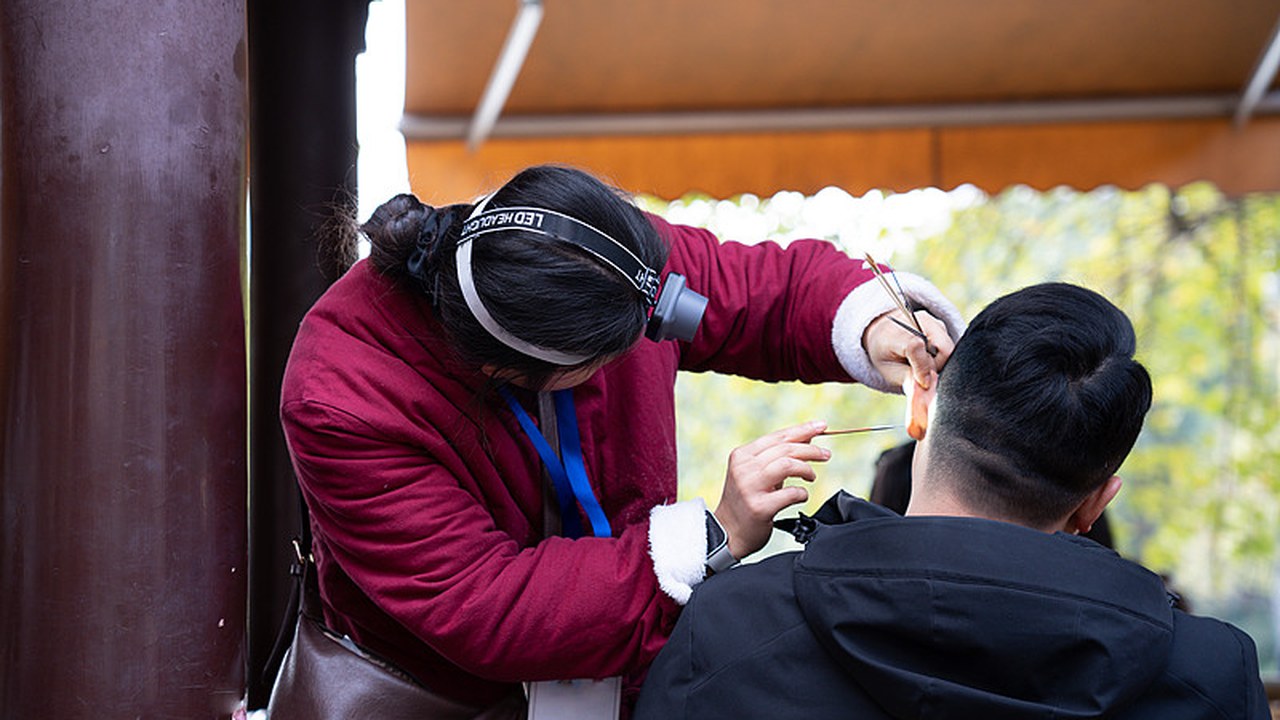
You don't need to book anything. You sit down in a bamboo recliner at a teahouse, or on a stool at a street stall. The master starts with a warm herbal pack pressed against your ear and neck for a couple of minutes — this part feels exactly like it sounds, a small hot compress.
Then comes the part that looks intimidating: a long slender metal pick, a curved scraper, a set of feather brushes, and a tuning fork. The master taps the fork, brings it near your ear, and the low hum seems to reset something in your head. The cleaning itself is quick and gentle — most sessions run 3 to 20 minutes — and ends with a soft feather brush sweeping around the inner ear. If you're doing the full version, a head, neck and shoulder massage follows.
Is it safe? The tools are sterilized, and by 2026 most teahouse masters use a fresh disposable tip for every customer for about ¥10–20 extra. If you have any ear condition, a doctor — not a street master — is the right call. For everyone else, it's a 20-minute shutdown button.
The Full-HD Effect: Why It Feels Weirdly Good
There's a reason people describe the aftermath like a sound system upgrade. Your ear canal is lined with one of the densest nerve networks in the body — the same reason whisper ASMR videos became a global genre. A skilled master's feather brush stimulates those nerves at close range, and the tuning fork adds a low-frequency vibration that travels straight through bone. The result: a head that feels lighter, hearing that seems sharper, and a calm that a spa day struggles to match. Nobody claims it's medicine. It's a 300-year-old way of turning everything off, and it works unreasonably well.
Why This Could Never Happen in the West
In the US and Europe, ear wax removal is a clinical thing. You book an appointment, a nurse looks into your ear with a scope, and you pay a specialist's fee for a procedure that feels like a doctor's visit. The idea of someone cleaning your ears in a public park, with a tuning fork and a feather, next to people drinking tea and playing mahjong, is culturally impossible. That gap is exactly why the videos work. Western viewers aren't just watching a service; they're watching a different idea of leisure — where a tiny, ancient comfort is ordinary, cheap and shared. China's teahouse culture turns healthcare-adjacent care into something social, and visitors walk away realizing they've never been this relaxed in public before.
What It Costs in 2026 (And What's Fair)
Prices are more transparent than you'd expect, because they're printed on signs at the big teahouses:
- People's Park, Chengdu: ¥30–50 for a standard clean (Chengdu local guides, 2026)
- Heming Teahouse: ¥30 for a 3-minute clean plus ¥20 for a fresh disposable tool kit; deeper work up to ¥100 (newspaper reports)
- Full package, clean plus massage: ¥70, as filmed by Nic Explores in October 2026
- Rule of thumb from local travel writers: if a teahouse quotes over ¥100, walk away and try the next master
To put that in perspective: ¥70 is about US$10. It's the same price as a cocktail in Shanghai, a fraction of what a haircut-and-massage would cost in London or New York, and for a traveler already in China on a 30-day visa-free entry it's the cheapest "wait, that actually happened" moment of the whole trip.
Where to Try It: Chengdu First, Then Everywhere
Start in Chengdu, where the tradition is oldest and the setting is best: People's Park. Buy a ¥15–30 cup of jasmine tea at Heming Teahouse, claim a bamboo chair by the lake, and wait for the ring of the tuning fork. It's a full afternoon activity: tea, people-watching, mahjong clatter, and one ear cleaning.
Outside Chengdu, ear cleaning is common across southern and central China. Chongqing's street stalls are famous for it, and most cities with old teahouses or foot-massage shops offer it as an add-on. In Shenzhen, a growing number of massage and wellness shops list it alongside foot therapy — easy to slot into an APEC-side-trip itinerary in November.
Three Checks Before You Sit Down
- Confirm the price first. The sign should match what you pay. Anything quoted over ¥100 for a standard clean is a tourist premium — pass.
- Watch for a fresh tool. Most masters will show you a sealed disposable tip. If they don't, ask.
- Skip it if you have an ear infection or a history of ear problems. This is relaxation, not medicine.
The 20-Minute Argument for Coming Back
Here's the thing: the "China experience" everyone posts about is usually a landmark, a meal, or a view. Ear cleaning is different. It's a tiny service you didn't know existed, delivered by a master who has done it tens of thousands of times, in a teahouse that has been running for a century. The whole thing costs less than a cocktail. And it gives you the one souvenir that fits in your carry-on: the sudden, absurd ability to hear in full HD.
Plan it into a Chengdu afternoon, or find the version that exists in nearly every big Chinese city. If you need help stacking it into a 10-day route with trains, teahouses and night markets, browse the experience guides on ChinaPie — that's what they're for.
What to do next
把采耳排进成都的一个下午:鹤鸣茶社点一杯 15-30 元茉莉花茶,占一把湖边竹椅,等音叉声;先确认价格牌、要求新拆封工具;重庆街边摊、深圳按摩养生店也有;用 30 天免签或 240 小时过境免签规划行程,到 chinapie.ai 体验与城市页搭配 10 天路线
What may vary
价格因城市与门店差异较大(30-100 元区间);一次性工具费 10-20 元是否为必选项因店而异;部分门店全套含头颈肩按摩(约 70 元);2024-2026 报道中人民公园采耳价 30-50 元与鹤鸣 30+20 元口径并存