
China High-Speed Rail Experience 2026: Beijing to Shanghai in 4h18m from ¥553 | China Travel
Beijing to Shanghai by high-speed rail: 1,318 km, four hours and 18 minutes, second class from ¥553 (about US$75). Here's why the 'standing coin' test keeps going viral, what the ride actually feels like, and how to book it without overthinking.
Key takeaway
China's high-speed rail is the world's largest network (40,000+ km of operating mileage). The flagship Beijing–Shanghai line covers 1,318 km in as little as 4h18m at 350 km/h, second class from ¥553 (about US$75). The viral 'standing coin' test — filmed on regular runs and reported by People's Daily as far back as 2017 — keeps going around because the ride really is that smooth.
Full report
Beijing to Shanghai by train: 1,318 km, four hours and 18 minutes, second class from ¥553 — about 75 US dollars. The fastest trains cruise at 350 km/h, and if you've seen any viral video out of China in the past decade you already know the visual: someone stands a coin on its edge on the window ledge, lets go, and it stays standing for the whole clip.
That coin test is a decade-old internet staple, and it keeps getting re-posted because it keeps being true. People's Daily ran a widely shared report on it back in 2017, and every new generation of visitors tries it for themselves. It works — every time.
Why the coin test became a China travel meme
Here's the part that feels like a party trick: the test isn't staged in a lab. It's a regular daytime run between Beijing and Shanghai, at cruising speed, and the coin just sits there. What makes it work is a welded seamless track, a train that accelerates and brakes like a lift, and suspension tuned to match. Foreign visitors film it because it looks fake. It isn't.
The numbers back up the vibe. China's high-speed network is the world's largest by a wide margin — official figures put the operating mileage above 40,000 km, more than the rest of the world's high-speed lines combined by most counts. A test train has reached 603 km/h in trials, which is why the 'world's fastest train' tag keeps surfacing on short-video platforms even though 350 km/h is the everyday commercial speed. In other words: the smooth ride tourists film is the boring normal here, not a special event.
What the ride actually feels like
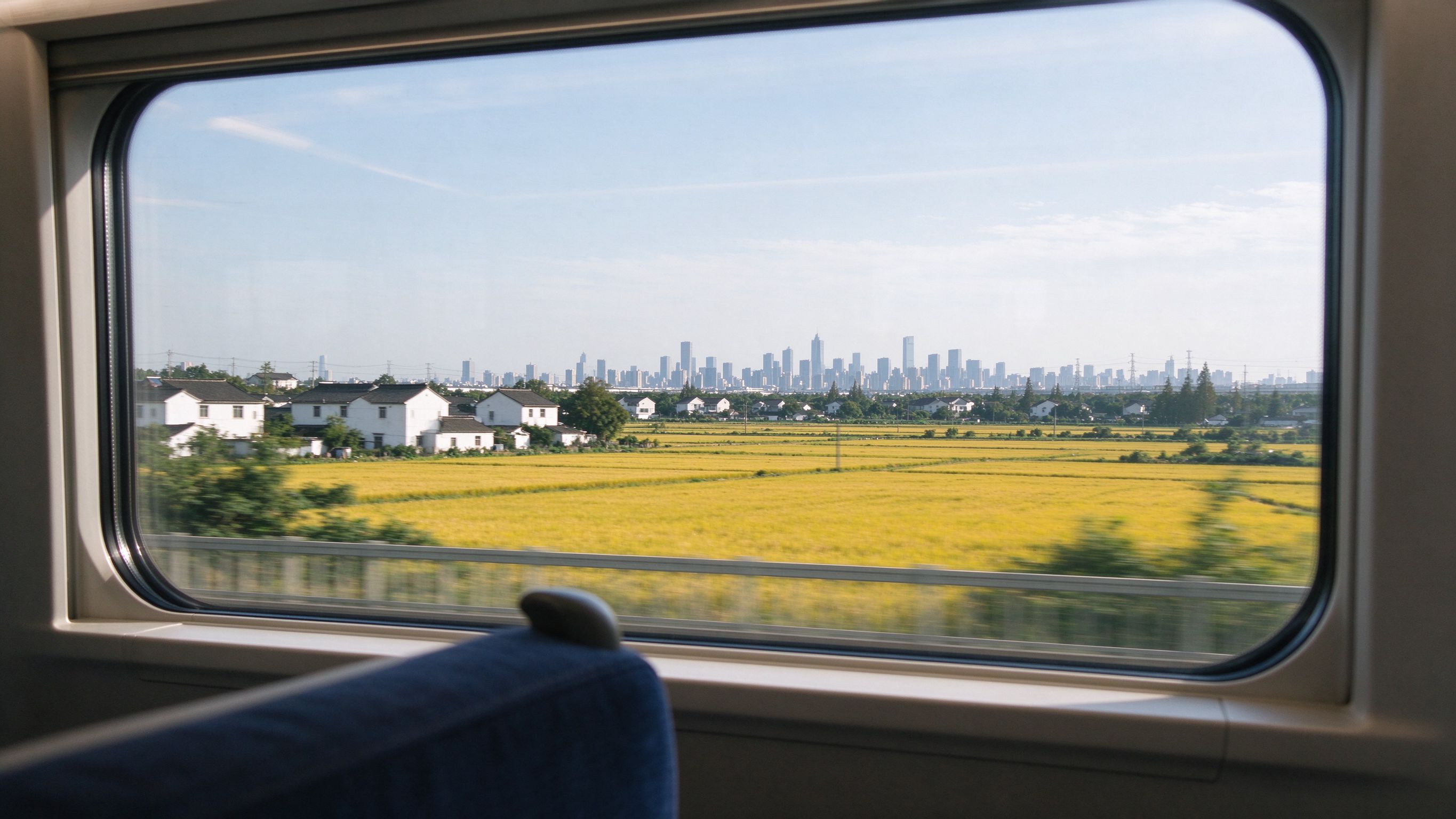
The Beijing–Shanghai run crosses North China's wheat flats, bridges the Yangtze, and slips past small towns you would never see from a plane. The windows are big, the seats are wider than economy on most airlines, and — the detail every first-timer mentions — you can stand up and walk around while the train is at full speed. The floor barely moves. Coffee stays put on the tray table.
Then there are the stations. Beijing South and Shanghai Hongqiao are airport-scale buildings with security screening, enormous departure halls and dozens of food counters selling noodles, dumplings and boxed meals before you board. First-timers routinely budget too little time for them; arriving 30–40 minutes early is the safe move.
On board, a meal service comes to your seat on the long runs — boxed rice or noodles, tea, snacks — and every seat has a charger. Quiet cars exist, and families with small children tend to self-sort into the middle carriages. The onboard washrooms are clean and, yes, usable at full speed.
Second class, first class, business class: what you're paying for
Second class is the default and the smart pick: ¥553 on the 1,318 km Beijing–Shanghai line, which works out to roughly US$75 — about 6 cents per kilometre. For context, that is less than what many people pay for a one-way regional flight in Europe or North America, and on this route the train is faster door-to-door than flying once airport security, transfers and waiting are counted.
First class runs about ¥929–1,100 depending on the train, and buys wider seats and a quieter car. Business class is the full experience at roughly ¥1,744–2,420: a proper reclining seat, a real meal, a quiet car, and a charger at every seat. A YouTube video comparing business class on this exact route has pulled in close to 900,000 views, and the recurring comment thread is the same — this would be a domestic-flight-upgrade price at home, and here it buys an entire flagship rail journey.
How to book it without overthinking
- Book on the official 12306 app or Trip.com. Passports work, and foreigners ride the same system as locals — same prices, same seats, no tourist markup.
- Bring your passport, not a paper ticket. At most major stations you scan the passport itself at the gate.
- Pick seat A or F on the booking map if you want the window side.
- Budget 30–40 minutes before departure. Security at the big stations is fast, but peak-hour queues are real.
- If you're travelling with a big suitcase, book a seat near the luggage racks at the end of the carriage, or use the overhead bins for smaller bags.
When the train beats the plane — and when it doesn't
On the Beijing–Shanghai corridor, the train wins almost every time. Add up taxi-to-airport, security, boarding, taxi-from-airport, and the train is usually two to three hours faster door-to-door — and it drops you in the city centre at both ends. Beijing South sits on the metro; Shanghai Hongqiao connects to two airports and the whole city network. The cases where flying still makes sense are long cross-country routes like Beijing to Urumqi, where the plane is genuinely faster, or last-minute departures when your preferred rail time is sold out.
The details first-timers notice
Cleanliness is the one that comes up in nearly every foreign review: floors, windows and washrooms are kept to a standard that surprises visitors used to trains at home. Announcements on major routes are bilingual. The onboard food cart and the station counters all take WeChat Pay and Alipay — and, increasingly, international cards.
On this route you can also book a sleeper instead. Overnight trains still cover the line in about 12 hours with second-class seats from around ¥338 and sleeper berths from roughly ¥516, which quietly replaces a hotel night for budget travellers. Most visitors, though, take the 4.5-hour daytime train and save the sleeper for longer legs like Shanghai–Kunming or Beijing–Harbin.
What people get wrong about the price
The usual assumption is that ¥553 must be a teaser rate with catches hidden somewhere. It isn't: that's the standard published second-class fare, the same one locals pay, with no foreigner surcharge and no surge at booking time. The differences you see in the booking list come from train type — the fastest G trains versus slightly slower ones — not from your passport.
Refunds and changes are another pleasant surprise. Tickets can be changed on the 12306 app right up to departure, and refunds land within minutes, which makes a rail plan more flexible than most flight tickets visitors have dealt with.
The value case in one sentence
You pay about the price of a nice dinner for a four-hour, 350 km/h ride across 1,300 km of China, on the network that turned the standing-coin test into a travel ritual — the same service that costs five to ten times more in most of the world.
That price gap is the whole point of this trip. Visitors who ride it once usually end up re-planning their whole itinerary around the rail map, because a country this size becomes a different place when you can cross it between breakfast and lunch.
Why it belongs on every China travel itinerary
The network changes the shape of a China trip. Day trips out of Shanghai to Suzhou or Hangzhou become 30–60 minute hops; Beijing to Xi'an for the Terracotta Army is about four and a half hours; the Yangtze Delta cities start to feel like one metro area. Travel YouTubers who film the experience — from business-class comparisons to first-timer vlogs — keep landing on the same line: it's the most comfortable, most reliable, best-value long-distance transport most of them have ever used. That's why the standing-coin clip resurfaces with every new wave of visitors: the novelty isn't a trick, it's the standard.
When you plan your route, chinapie.ai keeps the honest version of these experiences — real prices, what's worth it, what isn't — for visitors who'd rather spend on the trip than on the research. Put the high-speed rail ride in your China travel plan and see for yourself why the coin doesn't fall.
What to do next
Book on the official 12306 app or Trip.com, arrive 30–40 minutes early at major stations, scan your passport at the gate, pick window seat A or F, and pick second class for value or business class once for the reclining-seat experience — then re-plan your itinerary around the rail map.
What may vary
Fares vary by train type and travel date; fastest times depend on the specific G train. Beijing–Shanghai rail tickets can sell out at peak holiday windows, and station security queues grow at rush hours.