
One Year of China's Russia Visa-Free Policy: Weekend Border Trips, TCM Tourism and a Port City Transformed
China's unilateral visa-free policy for Russian passport holders is one year old. Border crossings in Heilongjiang are up 29.3%, weekend trips and TCM tourism are booming, and visitors are now heading deeper into China.
Key takeaway
China's unilateral visa-free entry for Russian passport holders (from Sep 15, 2025) is one year old: Heilongjiang border stations recorded 3.38M passenger trips (+29.3%), Russian arrivals hit ~617,000 (+76.9%), and Suifenhe welcomed 1.7M tourists in H1 2026 (+89.8% foreign arrivals) with TCM medical tourism and weekend cross-border trips on the rise.
Full report
One Year In: What China's Russia Visa-Free Policy Actually Changed
A year after China opened its unilateral visa-free entry for Russian passport holders on September 15, 2025, the numbers tell a story that goes well beyond tourism. Border stations in Heilongjiang province, China's northeast gateway to Russia, recorded 3.38 million inbound and outbound passenger trips over the past year — up 29.3 percent year on year. Russian arrivals specifically reached about 617,000, a jump of 76.9 percent.
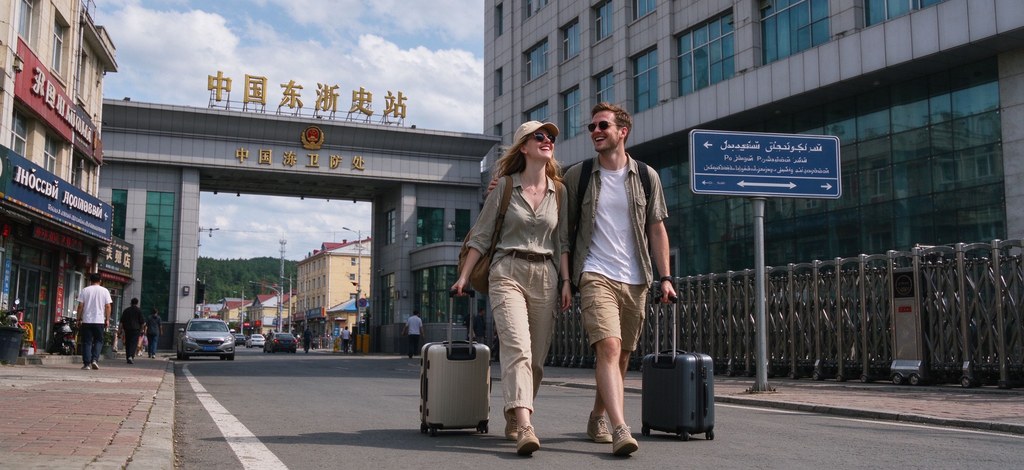
The port city of Suifenhe is where the change is easiest to feel. Bilingual broadcasts echo through the arrival hall as Russian travelers stream in. Andrey Suvorov, a tourist from Vladivostok, put it plainly: before, a visa application and worries about paperwork; now, a passport, a ticket, and go. Biometric verification and smart inspection devices have cut border clearance to minutes, with average clearance time down to two minutes.
Weekend Trips, TCM Tourism, and New Kinds of Spending
That convenience created a new rhythm: weekend cross-border trips. In the first half of 2026 alone, Suifenhe welcomed 1.7 million tourists and generated 1.87 billion yuan (about 279 million USD) in tourism revenue. The port saw nearly 140,000 inbound and outbound foreign tourists — an 89.8 percent surge year on year.
The visitors are also changing what they do once they arrive. Suifenhe People's Hospital now runs a dedicated reception room for Russian medical tourism, drawing travelers who want to try traditional Chinese medicine treatments like acupuncture and moxibustion. Shopping has moved beyond light consumer goods too: at the local used-car export base, Dima Vladimirov from Vladivostok said he had already picked out a Chinese car to buy. The policy dividend even shows up in freight — 1.1 million metric tons through the port by end-August, up 9.78 percent, a record high.
Beyond the Border: Russians Are Heading Deeper Into China
The effect isn't limited to border towns. In Sanya, on Hainan island, Russian visitors now account for more than 40 percent of inbound tourists, and Russian guest numbers at the city's hotels roughly doubled from 170,000 in 2024 to 350,000 in 2025. Cities like Chengdu and Leshan in Sichuan have also emerged as new favorites.
Nationwide, the pattern holds. From January to August 2026, foreign nationals made 61.29 million trips across China's borders, up 19.5 percent year on year; 23.72 million of those entries were visa-free, up 26.8 percent, according to CGTN's analysis of immigration data.
What This Means for Travelers
For independent travelers, the practical takeaway is straightforward: a growing share of visitors to China no longer need a visa, and the friction points that once kept people away — paperwork, language, payments — keep shrinking. Clearance is faster, Russian-language support exists at key ports (including a 24-hour consumer rights hotline and ruble payments in Suifenhe), and tax refund shops are in place.
The visa-free experiment was always bigger than tourism. It lowered the first barrier, and the year since has shown what happens after that barrier drops: people come, they stay longer, they spend differently, and some of them come back.
More China travel guides: China Visa Guide for US Travelers · China 240-Hour Visa-Free Transit Guide · China Trip Preparation Checklist · China Payments Life 101
What to do next
Check whether your passport country is on China's visa-free list, use the 240-hour transit policy for shorter stopovers, and plan weekend city trips that were impractical before — clearance at key ports now takes minutes.
What may vary
Visa-free eligibility and stay durations differ by nationality (Brunei no expiry, Russia until 2027-12-31, most others until 2026-12-31); port-level services like ruble payments and Russian-language support vary by city.