
China Travel Trend: Inside the 'China Spa' Bathhouses Tourists Are Hauling Their Suitcases To
The 'China Spa' is the surprise travel story of 2026: foreign tourists landing in Shanghai and Beijing are heading straight for Chinese bathhouses — soaking pools, buffets, PS5 lounges and a famous body scrub — with rolling suitcases in tow. It is not really a spa; it is a Chinese bathhouse, where one cheap ticket buys pools, sauna, food and hours of lounging, sometimes overnight. This guide explains what it actually is, why the price stops you cold, and how a first-timer should play it.
Key takeaway
'China Spa' is the TikTok nickname for Chinese bathhouses (tangquan): one cheap ticket buys soaking pools, sauna, a locker, a venue pyjama and hours of food, gaming and lounging — sometimes overnight. Shanghai's top venues now host 50+ overseas visitors a day, and foreign tourists arrive with suitcases; tickets start from a few dozen yuan, versus around 300 yuan for a basic Moscow spa. Key customs: shower before the pool, single-sex nude bathing, put on the pyjama in mixed areas, and book the cuoza body scrub as an optional paid extra.
Full report
The 'China Spa' Trend, Explained
Scroll TikTok and you will eventually meet it: a tag that reads "24 hour spas in China." Russian creators, Korean influencers and now travellers from across the West are posting from Chinese bathhouses — long steaming pools, lounge floors with beanbags, fruit-and-snack stations — and calling the whole experience "chaebol" treatment, after the lavish spa trips associated with Korean-drama billionaires (NetEase, 12 Sep 2026).
The shorthand these travellers have invented is "China Spa." On the ground, it is not really a spa in the Western sense. It is a Chinese bathhouse — a tangquan (汤泉) complex — where one entry ticket buys you the pools, the sauna, a locker, a pyjama, and usually many hours of eating, gaming, napping and watching movies. Foreign visitors have begun arriving with rolling suitcases, heading straight for Shanghai's bathhouses after they land (Shangguan News, 13 Apr 2026).
The Numbers Behind the Suitcases
This is no longer a niche joke. Several of Shanghai's leading bathhouse complexes now host more than 50 overseas visitors on an average day (NetEase, 16 Oct 2026). At the Shuiguo Tangquan branch on Wujiaochang, manager Du Huihui says bathhouses have become a hit inbound destination over the past six months, with dozens of overseas travellers passing through each day. "Even our temporary storage rooms are no longer enough," he told Shangguan News (13 Apr 2026).
The spillover is visible far beyond Shanghai. At the Qinghe Peninsula hot-spring resort in Shenyang, staff can handle twenty to thirty separate foreign tour groups on a single peak day, a manager surnamed Zhang told Beijing Youth Daily (28 Sep 2026). The backdrop is a broader boom: Shanghai received 9.3602 million inbound tourists in 2025, up 39% year on year (Shanghai Municipal Administration of Culture and Tourism, via NetEase, 12 Sep 2026).
Why the Price Stops You Cold
Part of the amazement is arithmetic. A standard ticket at a Chinese city bathhouse can start from as little as a few dozen yuan, and it usually covers the pools, sauna, locker and lounge — with food, fruit and drinks often included or cheaply added on.
Compare that with home. Wen Yao, a Russian MBA student at Dalian University of Technology who has visited 25 Chinese cities in three years, still finds the contrast sharp. "We have saunas at home, but it's not quite the same," he told Beijing Youth Daily (28 Sep 2026). Russian banyas rotate between hot and cold, he explains, but they do not come bundled with restaurants and entertainment. A regular Moscow spa ticket runs to around 300 yuan — and buys little more than basic steam and a soak. A private Russian sauna booked for a group costs roughly 500–600 yuan, food and fun not included.
A British traveller's viral video summed up the bundle in one breath: there is a Starbucks, you can play a PS5, chicken nuggets and salmon are on the buffet, and don't forget your swim trunks. Comments from overseas readers ran to "I love this" and "Looks amazing!" (Beijing Youth Daily, 28 Sep 2026).
What Actually Happens: A First-Timer's Walkthrough
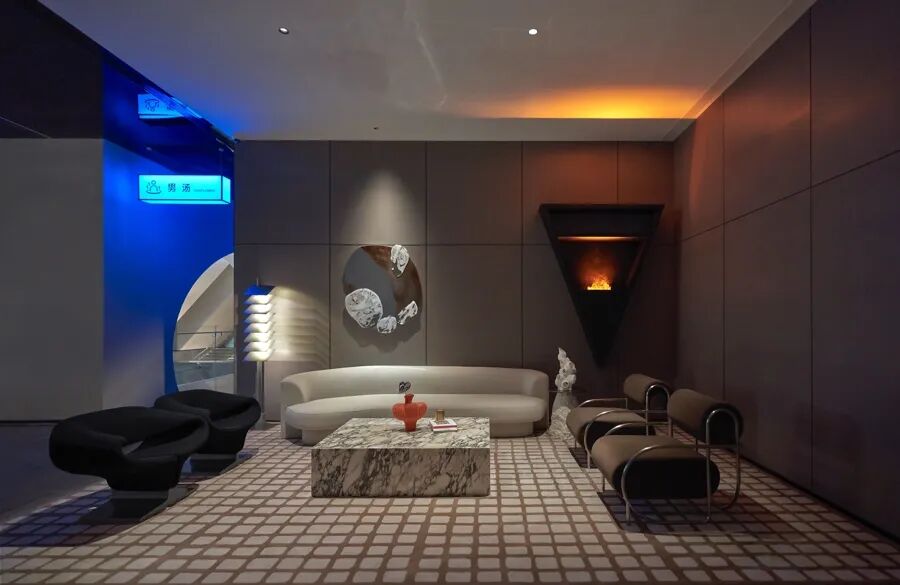
If you follow a regular, the afternoon goes like this. You pay at the entrance, hand over your shoes and get a wristband tied to a locker. Inside the single-sex changing and washing area, you shower first — the pools are for clean bodies. Then you soak in the various tubs, sweat out in the sauna, and optionally book a cuoza scrub. Afterwards you slip into a loose pyjama-like outfit the venue provides, and rejoin the mixed lounge: buffet, café, movie room, arcade, quiet corners. Many places let you stay overnight on a day bed or in a recliner, which is exactly why the "24 hour spa" tag exists.
The venues have noticed. Xiangshanghui Group, which runs the Shuiguo brand, says European, American and Australian guests are keenest on the body scrub and find it novel; its shops have switched signs and materials to bilingual Chinese-English and are hiring staff who speak foreign languages (Liu Zhe, North China marketing manager, China News Service·Huayu, 16 Oct 2026). Bathhouses have also added half-curtain dividers for privacy, printed Chinese-English-Russian information sheets and, since 2019–2020, steadily more bilingual signage (Beijing Youth Daily, 28 Sep 2026).
The 'Cuoza' Body Scrub, Decoded
The experience that turns first-timers into regulars is cuoza — the scrub, in which an attendant exfoliates your skin with a coarse mitt, usually in a private or semi-private cubicle. It is the detail that confuses and delights in equal measure.
Su Yao, a Russian graduate student in Beijing who has been in China for four years and visits a bathhouse every few months, was anxious at first. "The first time I saw everyone changing and bathing naturally together, I really couldn't get used to it," she told Beijing Youth Daily (28 Sep 2026). Over repeated visits she adjusted — and now she actively books the scrub. Kaoyilan, a Russian national working in livestream operations in Beijing, goes almost monthly; she traces the city's new popularity to one overseas blogger whose video of Beijing's No.9 Hot Spring "suddenly blew up," showing international viewers what Beijing bathhouses are actually like (Beijing Youth Daily, 28 Sep 2026).
Privacy, Etiquette and What to Bring
A few practical notes keep the trip relaxing. Single-sex washing and pool areas are nude, exactly like a Finnish sauna or an onsen — swimwear stays out of the water. Mixed areas are where the provided pyjamas come on. If the communal changing room feels exposed, ask staff about the scrub cubicles and private options; newer venues have added dividers specifically for guests who want more privacy. Bring a phone (in a waterproof pouch if you like photos), but respect that most indoor pool areas ask you not to photograph other people. Choose a well-reviewed chain near your hotel, check whether the ticket includes meals, and go on a weekday if crowds bother you — autumn and winter weekends get busy.
What to do next
Pick a well-reviewed chain near your hotel in Shanghai, Beijing or Shenyang; check online whether the ticket includes buffet meals and how long your stay lasts (many allow 8–24 hours, some overnight). Shower before entering the pools; expect single-sex nude bathing areas and put on the venue's pyjama in mixed zones. Bring your passport/ID and a phone; carry swim trunks only for the few mixed-pool or water-park sections. Book the optional cuoza scrub at reception if you want it, and ask staff about privacy cubicles if open changing feels uncomfortable. Visit on a weekday to avoid the busiest autumn and winter weekends.
What may vary
Service, food quality and facilities differ widely between venues — check recent English or travel-platform reviews before booking. Comfort with communal, single-sex nude bathing is personal: what Russian and Korean visitors have grown used to may take first-timers a visit or two to adapt to, and newer privacy dividers are a partial, not universal, fix. Peak weekends and winter holidays get crowded and storage fills up; prices, included meals and overnight policies change by branch and season.