
China Travel: Mount Siguniang Is Where the Influencer Wave Went Next
In eight days three foreign creators moved from city clips to high country. What Siguniang is, which valley actually shows Yaomei Feng, and how the ticket math really works.
Key takeaway
Mount Siguniang is a 6,250m massif in Xiaojin County, Sichuan, about 220km and four to four and a half hours by car from Chengdu, with the base town of Rilong at roughly 3,200m. Shuangqiao valley is the easy one but the main peak is not visible from it; Changping is where you stand under Yaomei Feng. Gate tickets are 80 yuan for Shuangqiao plus a 70 yuan shuttle, 70 plus 20 for Changping, and 60 for Haizi, but a 2026 two-valley combo sells for 110 yuan.
Full report
The videos changed direction
For two years the China Travel feed looked the same. A monorail sliding out of an apartment block in Chongqing. A night market at 1am busier than a European high street at noon. A suitcase unpacked on a hotel bed, tags still attached. Global Times reported in early November that the China Haul hashtag alone passed 110 million TikTok views.
Then, inside eight days, the clips started showing snow.
CGTN's November 8 story follows Chinese American creator Sherry Zhu, who built an audience with "Becoming Chinese" videos, out of the studio and up to Mount Siguniang in Sichuan. China Daily ran a November 9 piece on an Italian blogger stopped cold by Yunnan's karst. On November 1, China News Service interviewed a British vlogger with millions of followers who summed up Xizang in three words: atmospheric, photogenic, friendly.
Three pieces, three provinces, one direction. City shock is easy to film from a taxi. A 6,250m massif is not.
What Siguniang actually is
Mount Siguniang sits in Xiaojin County, Aba Tibetan and Qiang Autonomous Prefecture, about 220km west of Chengdu: four to four and a half hours by car, the last stretch climbing through Wolong.
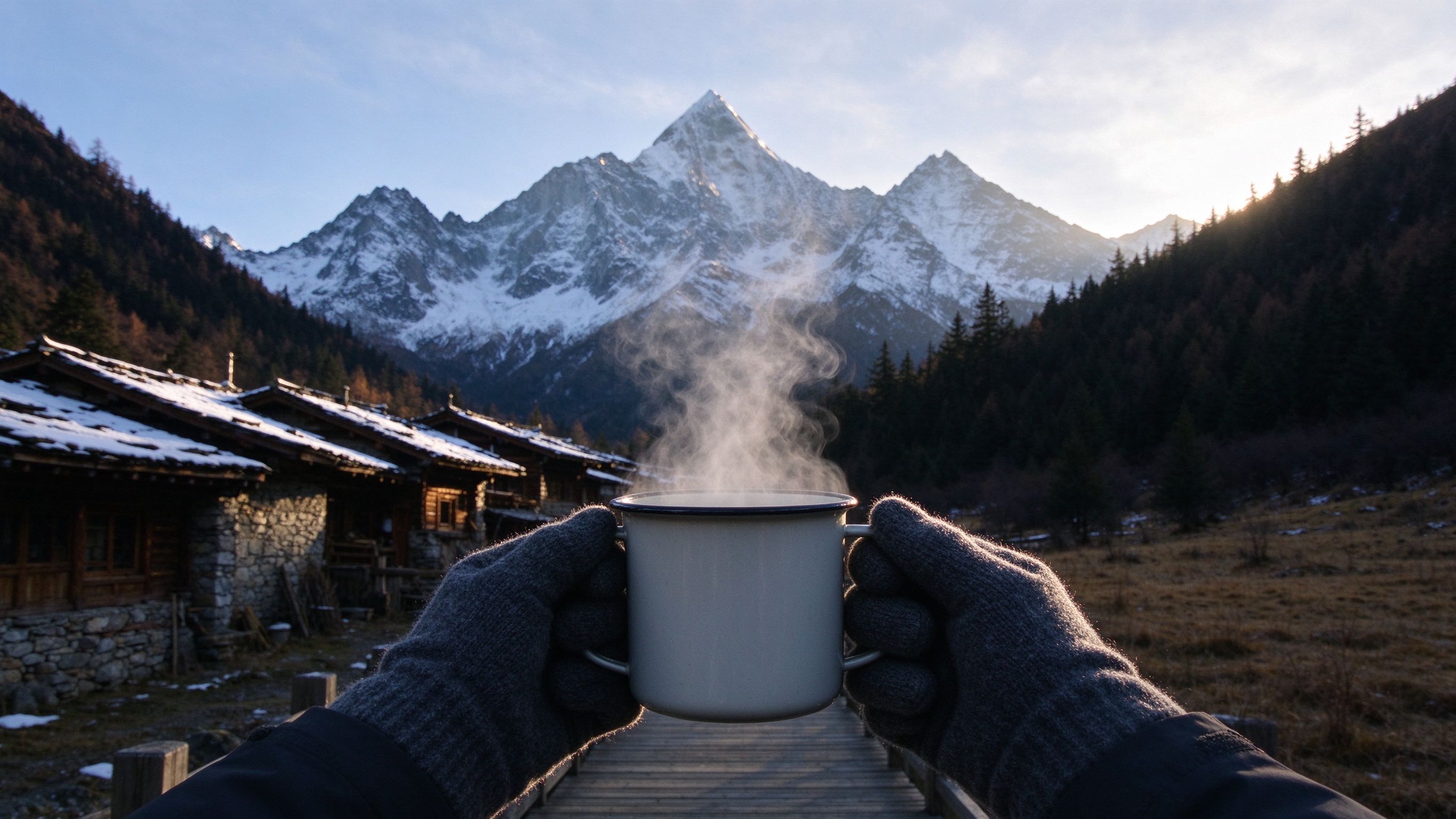
The name means Four Girls Mountain: four summits in a row, the tallest Yaomei Feng at 6,250m. Nobody on a normal trip climbs it. You look at it, and the looking is the point.
Everything starts in Rilong, the Tibetan town at the mouth of the valleys, at roughly 3,200m: tickets, shuttles, guesthouses, the noodle shop open past nine.
The valley that hides the mountain
Three valleys come off the same massif and are not interchangeable, which most itineraries get wrong first.
Shuangqiao is the postcard: about 35km of shuttle road and boardwalk, and you can see the whole valley on foot in under a kilometre. It is also the valley where the main peak is not visible. Snow, forest, yaks and a very good photograph. Just not the mountain the place is named after.
Changping is where you stand under Yaomei Feng. Twenty yuan buys the bus to the Lama Temple trailhead; after that you walk, flat boardwalk first, then climbing. The peak clears the trees about forty minutes in and then stays there.
Haizi is the hiking valley. No bus, 60 yuan, meadows and lakes, half a day minimum. It is the one people cut first, and the one that feels least like a scenic area.
The ticket math nobody explains
Peak season runs April 1 to November 30. Single-valley prices look cheap: 80 yuan for Shuangqiao, 70 for Changping, 60 for Haizi. Then come the shuttles: 70 yuan in Shuangqiao, 20 in Changping, none in Haizi.
So Shuangqiao on its own is 150 yuan, for the valley without the peak.
The scenic area's own 2026 notice, valid February 1 to December 31 excluding public holidays, sells a two-valley combo for 110 yuan and a three-valley combo for 150. That is gate tickets only, shuttles still separate. Two valleys on the combo cost less than Shuangqiao plus its bus, and one of them has the mountain in it.
The counterintuitive part: the cheapest-looking single ticket is the worst buy, and the combo is the thing nobody mentions at the gate.
Altitude is the real gate
The park's ticket page puts accommodation at about 3,200m and warns most visitors will feel altitude. That, not fitness or gear, decides whether the trip works.
Sleeping at 3,200m the first night, four hours after Chengdu at 500m, is the mistake that ends trips early. The fix is unglamorous: arrive in the afternoon, eat light, skip the alcohol, walk slowly, put the high valley on day two. A pulse oximeter and headache tablets cost less than a wasted day.
Getting there without wasting a day
Driving or hiring a car is simplest: four to four and a half hours from Chengdu. Buses leave Chadianzi station toward Xiaojin and Rilong, but mostly early morning, so same-day arrival plus a full valley is optimistic.
Gates run 8:00 to 15:00; last entry is a hard stop, and November dark comes early. Peak pricing ends November 30, which cuts both ways: cheaper tickets, shorter days, ice on the boardwalks.
The trade-off
Siguniang is not a budget-hunting stop. Two days here cost more than a week of night markets, and the mountain does not perform on cue: cloud can sit on Yaomei Feng for three days.
What you get instead is what this wave is chasing: a place that cannot be filmed from a car window. If the trip is Sichuan plus one mountain, this is the one. If it is a first China trip with three cities in ten days, leave it for the second.
What to do next
Pick Changping if the point is the mountain, and pair it with Shuangqiao only on the two-valley combo rather than buying Shuangqiao alone with its shuttle. Sleep in Rilong on arrival night, keep the first day flat, and put the higher valley on day two. Check gate times before leaving Chengdu because last entry is 15:00.
What may vary
Ticket prices and combo rules are set seasonally and can change; the combo excludes statutory public holidays. Shuttle operations, trail conditions and snow closures vary with weather, and visibility of Yaomei Feng is not guaranteed on any given day.