
China Travel's Second Stop: Why Repeat Visitors Are Heading to the Hexi Corridor Silk Road
Already done Beijing, Shanghai and Guangzhou? A fast-growing share of foreign visitors are extending their China Travel itinerary west to Gansu and the Hexi Corridor. Inbound visits to the province rose 60% in the first eight months of 2026, and agents say European and North American travelers are planning ten-day-plus trips along the old Silk Road.
Key takeaway
Foreign travelers who have already done Beijing, Shanghai and Guangzhou are adding the Hexi Corridor to their China Travel list: Gansu hosted 349,500 overseas visitors in Jan-Aug 2026 (+60%, Gansu Dept. of Culture & Tourism), and 393,900 inbound visits in full-year 2025 (+60.8%, Gansu Public Security Dept.). The classic route runs Lanzhou → Wuwei → Zhangye → Jiayuguan → Dunhuang (Mogao Caves, Mingsha Mountain & Crescent Lake), with Gannan grasslands and Lanzhou beef noodles as add-ons. Eight international routes operate now, charter load factors exceed 88%, and Ctrip forecasts another +50% next year. Trips last 10+ days; book English-speaking guides early and request Russian/Spanish guides months ahead.
Full report
Why Gansu Is Becoming China's "Second Stop
Many of the foreign travelers now heading to Gansu have already done the classic first trip. Zhang Ye, planning director at Gansu Junhe Cultural Tourism, puts it plainly: the overseas visitors who arrive in Gansu have usually already been to Beijing, Shanghai or Guangzhou, and now want to see a different part of the country. "They may have already been to Beijing, Shanghai, Guangzhou and then they come to Gansu" for landscapes and heritage they cannot find in the coastal cities (China News Service · Huayu, 16 Oct 2026).
The numbers back the shift. Gansu's culture and tourism authority reports 349,500 overseas visitors in January–August 2026, up 60% year on year (China News Service · Huayu, 16 Oct 2026). For full-year 2025, Gansu received 393,900 inbound visits, up 60.8%, including 199,500 foreign nationals (+56.5%) and 98,000 visitors from Hong Kong and Macau (+52%), according to the Gansu Provincial Public Security Department (China Daily, 28 Feb 2026). Dunhuang alone drew 809,300 visitors over the 2026 Spring Festival holiday, up 48.11%, with an estimated 479 million yuan in tourism spending (China News Service, 25 Feb 2026).
The Classic Route: Wuwei → Zhangye → Jiayuguan → Dunhuang
The draw is the Hexi Corridor, the narrow historical passage where the ancient Silk Road ran between the Qilian Mountains and the Gobi. Agents consistently line up four stops — Wuwei, Zhangye, Jiayuguan and Dunhuang — strung together by the archaeological and architectural remains of that old trade route (China News Service · Huayu, 16 Oct 2026).
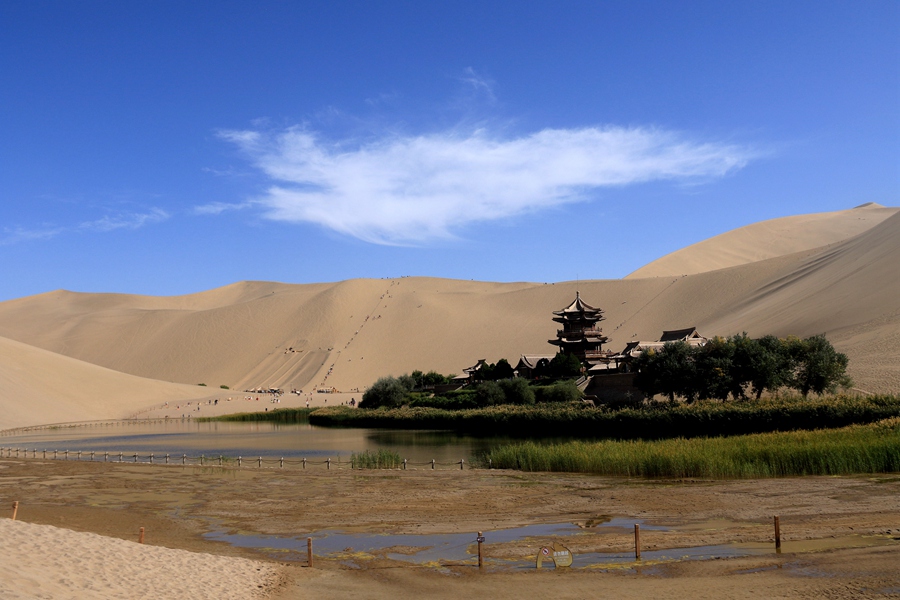
Dunhuang anchors the western end. The Mogao Caves, a millennium-spanning complex of Buddhist grottoes, and the Mingsha Mountain dunes with the Crescent Lake spring are the two sites foreign visitors name most often. Beyond the corridor, some itineraries add the grasslands of Gannan in southern Gansu, and nearly every trip passes through Lanzhou long enough for a bowl of beef noodles (China News Service · Huayu, 16 Oct 2026).
Flights, Routes and the 2027 Forecast
Getting there keeps getting easier. Gansu now operates eight international and regional routes, with three more planned by the end of August 2026, according to the 2026 Gansu Inbound Travel Trade Summit held in Lanzhou (Xinhua, 22 Apr 2026). Charter services on Lanzhou–Seoul, Lanzhou–Kuala Lumpur and Dunhuang–Hong Kong ran at average load factors above 88% during holidays (China National Radio, 9 Oct 2025). Ctrip forecasts that Gansu's inbound visits could grow another 50% in the same period next year (China National Radio, 9 Oct 2025). The province is also working toward 30-plus departure tax-refund stores and a one-stop service system for incoming visitors (Gansu Provincial Government, 28 May 2026).
The visitor mix is changing as well. Gansu's inbound traffic used to come mainly from Southeast Asia; in the past two years European travelers and a smaller wave from North America have grown. Where trips once lasted about a week, they now stretch to ten days or more (China News Service · Huayu, 16 Oct 2026).
Practical Tips: Visas, Timing and Booking
Visa-wise, many repeat travelers can benefit from China's relaxed entry rules: unilateral visa-free treatment now covers 50 countries, and the 240-hour transit visa-free policy applies to 57 countries (Xinhua, 11 Oct 2026), which makes a multi-city Gansu extension far easier to arrange.
Book early. European and American clients typically start enquiries about a year ahead and confirm plans half a year in advance — agents are already discussing trips for August and September of next year (China News Service · Huayu, 16 Oct 2026). Guides are the bottleneck: English-speaking guides are relatively available, but Russian- and Spanish-speaking guides are scarce and often have to be coordinated in from Xi'an or Chengdu, so request them as early as possible. The best window for the corridor is May to October; note that peak-season Mogao Caves tickets are in tight demand and sell out quickly, so reserve grotto visits through official channels well ahead.
What to do next
Build a 10–14 day Lanzhou → Wuwei → Zhangye → Jiayuguan → Dunhuang loop, adding Gannan grasslands or a Lanzhou beef-noodle stop. Check whether your passport qualifies for unilateral visa-free entry (50 countries) or the 240-hour transit visa-free policy (57 countries). Reserve Mogao Caves grotto tickets through official channels months ahead in peak season, and request Russian- or Spanish-speaking guides at the same time — they are scarce and coordinated from Xi'an or Chengdu.
What may vary
Peak-season Mogao Caves tickets sell out fast and reservation windows are limited; non-English (Russian, Spanish, etc.) guides are not locally based and must be sourced from other cities, so lead times are longer. Charter flight schedules on Lanzhou–Seoul/Kuala Lumpur and Dunhuang–Hong Kong are seasonal and holiday-focused. Gansu's departure tax-refund store network is still being built toward a target of 30+ stores.