
Night Markets Just Became the China Travel Golden Week Must-Do: ¥4 Pancakes and 800-Stall Streets
China Travel Golden Week 2026: night markets are the new must-do. 4-yuan pancakes, 800-stall streets, prices a fifth of the West. Plan your food crawl.
Key takeaway
Night markets are the breakout China Travel experience of Golden Week 2026: a viral clip shows a full street-food meal for the price of one European pancake (4 yuan vs 4 euros), Yiwu's 800-stall Santing Road market got People's Daily coverage, and inbound arrivals grew double digits with Russia up 173%.
Full report
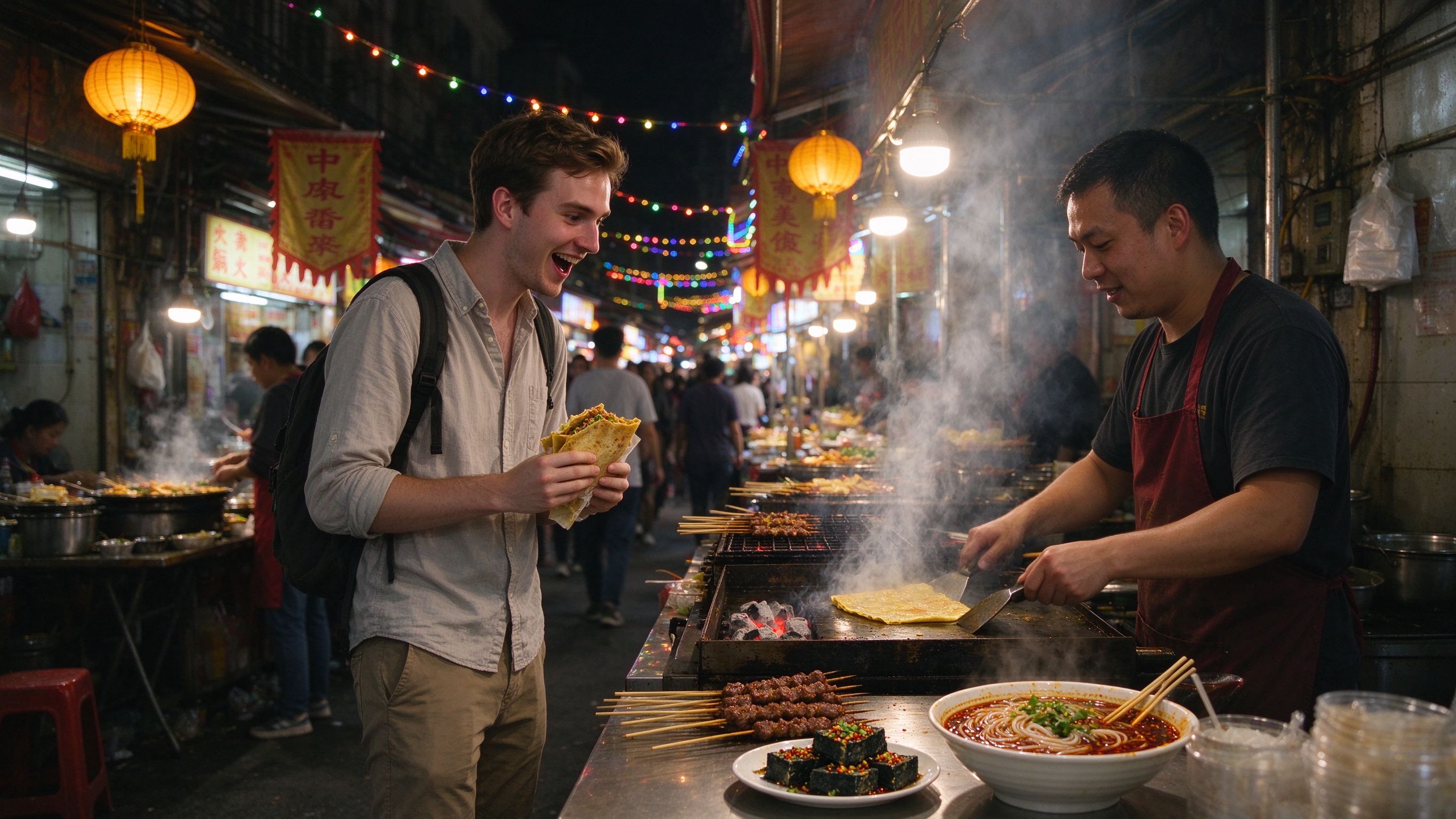
The viral video that keeps doing the rounds this season shows a foreign traveler in a Chinese night market holding up a steaming pancake. "This costs me 4 yuan," he says. "In Europe, this would be 4 euros." Five beef skewers, 10 yuan. A bowl of rice noodles, 10 yuan. A full evening of eating for less than the price of a sandwich back home.
That clip — 4 euros to 4 yuan — is basically the whole Golden Week story in one frame. Night markets have stopped being a "if there's time" add-on and become the destination itself.
The 800-stall street that sells the world
The best place to feel this shift right now might not be Shanghai or Chengdu. It's Yiwu, the small city in Zhejiang that supplies half the world's trinkets. Its Santing Road night market — 350 meters of street, over 800 stalls — was covered by People's Daily this summer as a "microcosm of a world supermarket." A foreign visitor named Julio was quoted mid-crawl: one moment eating local barbecue skewers, the next carrying a bowl of cold-pickled seafood, then stopping at a stall selling flavors from across China and beyond.
That's the twist that makes China night markets different from, say, a food hall in Bangkok or a market in Mexico City: the stalls themselves are global. Turkish kebabs next to Yunnan grilled cheese next to Guangdong garlic oysters. You can eat your way around the continent in one evening, and the prices stay local.
Golden Week is the season for it
National Day week (Oct 1-7) is when the night market calendar gets packed. Shanghai kicked off its Xuhui "Boundless Food & Light" carnival on Sept 30 with a noodle-focused festival — 40-plus vendors, noodle blind boxes, and a "thief-eating contest." Chengdu's Tiexiangsi Water Street food market runs through Oct 7, free to walk in. Xiamen is doing a three-night "Wonderful Night Market" with 40 stalls of Minnan snacks and local hotel desserts. Beijing has over 2,000 cultural events for the holiday, and a large share of them are night markets and themed bazaars.
For inbound travelers, the timing lines up with the strongest visa-free push China has ever run. Foreign arrivals grew double digits during the Mid-Autumn–National Day stretch; Russia was the No. 1 source market at +173%, and the UK, Malaysia and Canada all grew over 50%. Luoyang topped the culture-experience rankings, and Zhangjiagang-style second-tier destinations grew even faster. The trend inside the numbers: visitors aren't just crossing off landmarks anymore. They want the parts of China that locals actually live in — and that means the markets.
How to do a night market properly
A few rules from watching travelers do this well:
- Go late, not early. Markets peak after 8 PM. The same stall that's quiet at 7 will have a line and fresher food by 9.
- Eat in rounds. The mistake is filling up on the first skewer. Order small from five or six stalls — you'll end up with a full meal for ¥30-50, about $4-7.
- Carry cash or Alipay. Most stalls take mobile payments; some smaller ones are cash-only. A ¥10 note covers most snacks.
- Try the things you can't name. Stinky tofu, grilled cold noodles, jellied tofu pudding, Yunnan grilled cheese — the unfamiliar ones are usually the reason locals queue.
Prices to anchor yourself: grilled skewers ¥5-15, rice noodles ¥10-15, stinky tofu ¥8-12, fresh fruit cups ¥10-15. For context, a comparable street-food evening in London or New York runs $30-50. Same experience, roughly a fifth to a tenth of the price — which is exactly the value equation ChinaPie exists to help travelers find.
The takeaway
Golden Week 2026 is going to be remembered less for Great Wall crowd shots and more for market alleys packed with first-timers discovering that Chinese street food is both incredible and absurdly cheap. If you're planning a trip this month, build one evening around a night market. It's the one "attraction" that costs nothing to enter, needs no reservation, and gives you the most honest version of a city.
Want the full rundown on which markets to hit and what to order? Our Golden Week guide breaks it down city by city: https://chinapie.ai/blog/china-golden-week-2026-travel-experiences/
What to do next
Go to a night market after 8 PM when food is freshest and stalls are at full swing; eat in rounds of small orders across 5-6 stalls for a full meal at ¥30-50; carry a ¥10-20 note plus Alipay since some stalls are cash-only; try the unfamiliar items like stinky tofu, grilled cold noodles and Yunnan grilled cheese — they are usually why locals queue.
What may vary
Market hours and stall lineups shift by city and holiday; peak nights (Oct 1-3) draw bigger crowds and longer queues at the most famous stalls; some top-tier night markets in Shanghai and Chengdu can be tourist-heavy during Golden Week, so a smaller local market often gives a more relaxed experience.