
Night Markets Get a Fine-Dining Upgrade: Golden Week 2026's Newest China Travel Experience
Golden Week 2026 is turning China's night markets into fine-dining streets: Black Pearl chef stalls in Shenzhen, a museum food fair in Shanghai, heritage masters in Chengdu.
Key takeaway
Golden Week 2026 has upgraded China's night markets into fine-dining experiences: 19 Black Pearl-listed restaurants on one Shenzhen street, a museum food fair in Shanghai, and heritage masters in Chengdu — street food at 1/5 to 1/10 of home prices.
Full report
What Changed
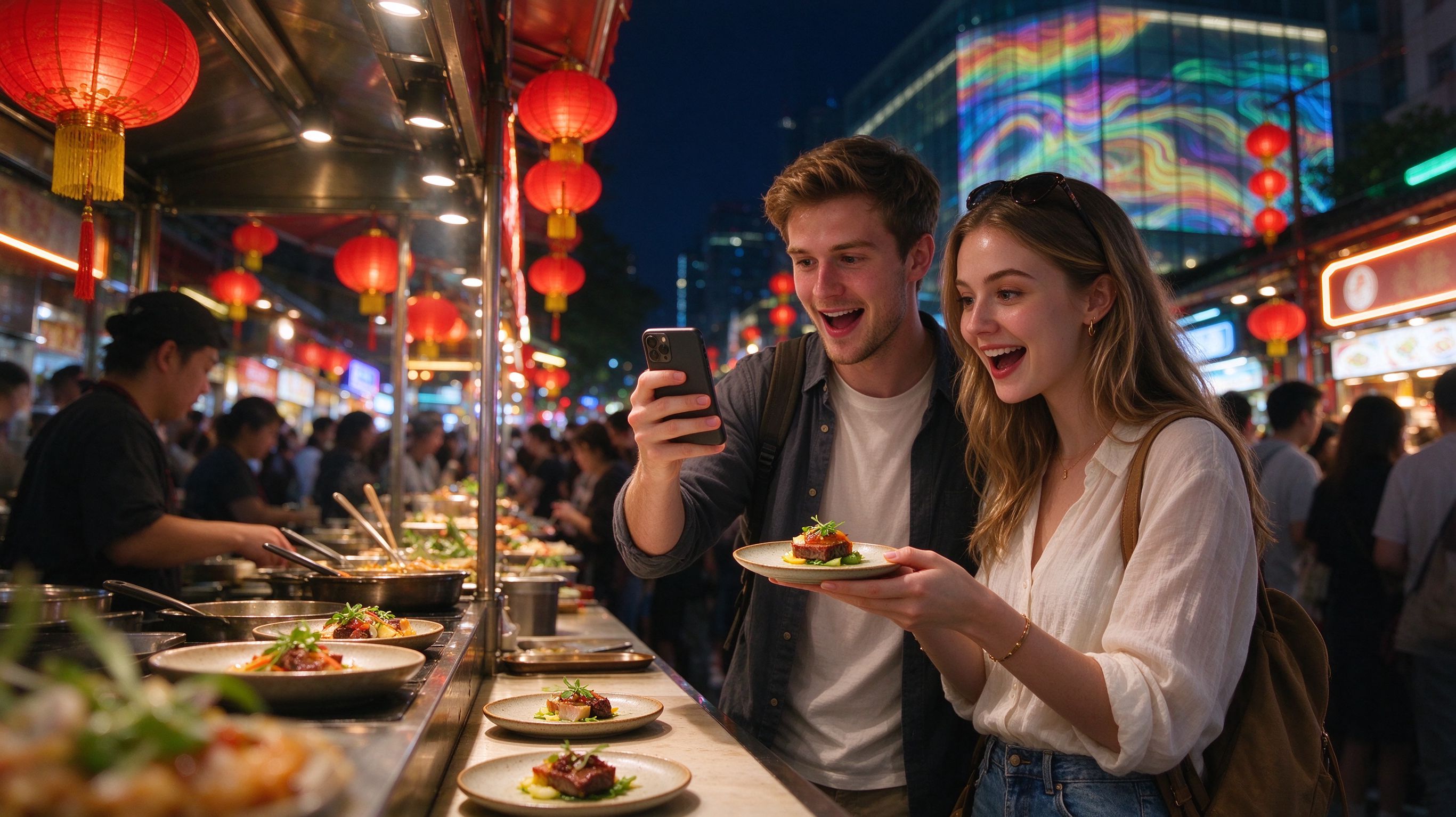
Golden Week 2026 has upgraded China Travel's night markets into something new. The old image — plastic stools, a grill, a student crowd — is still there, but no longer the whole story. This National Day, the best night scenes are being built by fine-dining chefs, museums, esports tournaments and heritage masters. In Shenzhen, 19 Black Pearl restaurant guide-listed restaurants moved onto one street. In Shanghai, a museum opened a Latin American food night market on its plaza. In Chengdu, an AI popcorn machine reads your mind while a pastry master sells a thousand portions a day.
Black Pearl Chefs Take Over a Shenzhen Street
From October 1 to 7, the Black Pearl Tide Food Market took over Wanxiang Street in Shenzhen's Luohu district. The lineup is unprecedented for a street fair: 19 Black Pearl-listed restaurants — two three-diamond houses (Xin Rong Ji and Yong Fu), one two-diamond, sixteen one-diamond — covering 13 regional cuisines, 12 of them flown in from other cities.
Normally these restaurants need weeks of advance booking. At the market, each kitchen compressed its signature dish into a street-portioned version: a chef's representative plate, a market-only flavor, or a dish that never appears on the regular menu. Fifteen Black Pearl chefs also took the stage to cook a full course in front of the crowd, handing out samples straight off the pass. No reservation, no private room, no minimum spend.
A Museum Opens a Food Night Market in Shanghai
Shanghai's most talked-about night market this Golden Week is not on a commercial street. The Shanghai Museum reopened its "Flavors of the Americas" night market on the south plaza of its People's Square building, October 1–7, 6–10 pm. It accompanies the museum's exhibition on ancient American civilizations — and the food goes beyond street clichés: Mexican BBQ, freshly steamed crayfish, and a limited "Americas roast mooncake," a National Day twist on the mooncake tradition. A Mexican Mariachi band patrols the stalls, and a "Corn God's kitchen" game lets visitors try traditional games.
Visitors collect stamps in a "Chocolate Passport" — each restaurant has its own seal, and different stamp levels unlock perks along Huaihai Road. Eating at a museum plaza, watching a performance, and collecting city-wide rewards in one evening: that's the new shape of Shanghai night culture. Nearby, the Bund's BFC mall pairs an esports street market (Valorant Shanghai Champions, daily 3–9:30 pm) with an AI experience center where robot dogs and AR glasses share space with 3D printers.
Heritage Masters Meet Street Food in Chengdu
In Chengdu, the "Beautiful Life" market at Tiesiang Temple Water Street gathers 10 cities, 60 vendors and 200-plus products through October 7. The star is the old-school guokui pastry, made by Pan Xiaobo, a municipal intangible heritage inheritor whose family has run the stall for over 30 years. He sells about 1,000 portions a day. Next door, a tech booth sells popcorn made from brainwaves: visitors wear a headset, concentrate on "thinking of popcorn," and the machine pops it.
Further south, Foshan's Kung Fu Night Market — rated one of China's Top 10 night markets — reopened its second phase with 130 new stalls, joining roughly 500 food and craft vendors. The theme is martial arts: lion dancers and vendors who flip squid while dancing to loud music. Indian and Russian business travelers from the Canton Fair were among the first to queue.
What Travelers Should Know
- Go between 6 and 8 pm. Stalls are fully set up, queues are shorter than the 9 pm peak, and the light is best for photos.
- Eat like a local: one dish per stall. A group of four sharing can cover six to eight stalls a night. Most markets cost 40–80 yuan per person for a full evening.
- Pay with your phone, carry small cash. Alipay and WeChat Pay work at nearly every stall; a 50-yuan note is a useful backup.
- Queue where locals queue. Long lines are usually the quality signal, not a tourist trap.
- Book the experience, not just the meal. The newest markets bundle food with performances, games and crafts. Look for stamp-card trails and chef sessions.
Why Night Markets Fit the New China Travel
The same logic that made hanfu shoots and countryside walks bucket-list items now reshapes night markets: an experience, an emotion, and a price that beats home alternatives — often by a factor of five to ten. A street meal in Shenzhen or Shanghai costs roughly what a single drink costs in a Western city center.
Golden Week is the window to see it. Pick a night, skip the hotel dinner, and let the street be your itinerary.
What to do next
Go between 6 and 8 pm, eat one dish per stall, pay with Alipay/WeChat plus a 50-yuan cash backup, queue where locals queue, and look for stamp-card trails and chef sessions to turn dinner into an evening.
What may vary
Vendor lineups, hours and stamp-card perks vary by city and day; confirm current dates and locations before traveling during Golden Week peak.