
China Night Markets 2026: Where Inbound Travelers Find the Loudest Welcome
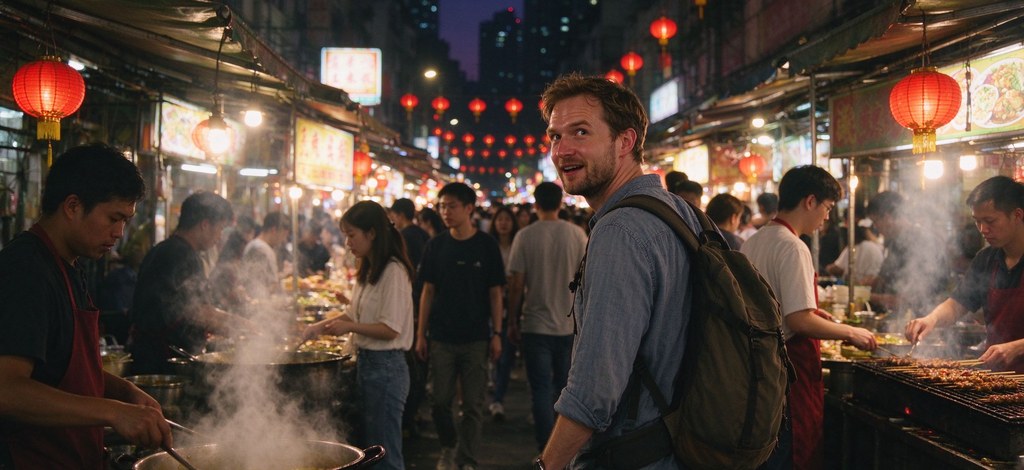
Golden Week data made it official: China's night economy is where inbound travel comes alive, with night spending up 62% year on year. Night markets are also the most foreigner-friendly, low-risk, high-value way into Chinese food culture - no menus to read, QR payments that work with foreign cards, and full meals for the price of a single cafe latte back home.
Key takeaway
China's night economy is the strongest first-timer entry point into China travel: Golden Week night spending rose 62% year on year (Tongcheng Travel rankings), the Starlight Night Market in Xishuangbanna drew 90,000+ visitors in two days, and foreign-friendly markets like Xi'an's Muslim Quarter serve full meals for about 10-15 USD. Night markets need no menu reading, QR payments accept foreign cards, and a full meal runs 50-100 RMB.
Full report
The Golden Week Numbers Behind Night Tourism
China's night economy had its busiest holiday on record during 2026 Golden Week. According to Tongcheng Travel's night-economy heat rankings, night spending nationwide rose 62% year on year, with young locals and inbound travelers alike flooding into street markets after dark.
The most-watched market of the holiday was the Starlight Night Market in Xishuangbanna, Yunnan - nearly 3,000 stalls spread across six-country-style zones, welcoming over 90,000 visitors in its first two days alone. In Changsha, the Yangfan and Huangxing Road markets were packed past 2 a.m. Haikou's Haida South Gate Night Market was featured in state media for its lanterns and stallholder shouts mixing with tourist laughter.
Why Night Markets Are the Best First Experience in China
For first-time visitors, a night market is the easiest possible introduction to China travel, and it works on three levels.
No menu, no language barrier. You point at what looks good, pay, and eat. Most vendors in tourist-heavy markets now take Alipay or WeChat Pay via QR code, and both apps accept foreign cards, so you don't need cash and you don't need to read a single character.
It's where locals actually are. Unlike a landmark you photograph and leave, a night market is a living neighborhood. You hear families bargaining, watch teenagers sharing skewers, and feel the rhythm of a Chinese city after dark.
The price gap is the point. In Yiwu, Zhejiang - the export hub foreigners already know - the Santing Road night market stretches 350 meters with more than 800 stalls. People's Daily Overseas Edition reported that Julio, a foreign visitor wandering the market, grabbed a round of grilled skewers and then a bowl of marinated seafood, describing it as a "miniature world supermarket" where you can taste specialties from across China - and the world - in one evening. A full meal with drinks runs roughly 50-100 RMB (7-14 USD), a fraction of what the same evening costs in most big cities.
Four Night Markets Worth Building a Trip Around
- Xishuangbanna Starlight Market (Yunnan): Nearly 3,000 stalls, Dai-Thai architecture, hand-grabbed rice and grilled fish wrapped in banana leaves. The most visually spectacular market in the country.
- Yiwu Santing Road (Zhejiang): 800-plus stalls on a 350-meter street. Global food, export-hub prices, and a genuine cross-cultural crowd.
- Xi'an Muslim Quarter: The most foreigner-friendly market in China - English menus are common and vendors are used to tourists. Hand-pulled noodles, rou jia mo lamb burgers, sesame persimmon cakes. About 10-15 USD per person for a full meal.
- Haikou Haida South Gate (Hainan): Seaside island street food, fresh seafood, and a relaxed tropical night-market atmosphere.
How to Do a Night Market Right
- Go early for the best picks, or late for the atmosphere - most markets run 6 p.m. to midnight or later.
- Bring your phone, not cash. Set up Alipay or WeChat Pay with a foreign card before you arrive; both work at QR stalls.
- Start with small portions from several stalls instead of one big plate. Half the fun is the tour.
- Trust the long lines. A queue outside a stall in China is almost always locals waiting for something worth waiting for.
- Ask the vendor to make it "not spicy" ("bu la") if you're easing in - most will happily oblige for a foreigner.
The Takeaway
Night markets solve the three things every first-time China traveler worries about: what to eat, how to pay, and where to feel welcome. Golden Week data says the rest of the world is catching on - 62% more night spending year on year, and the most crowded markets are the ones where you can point, pay and eat without saying a word.
More China travel guides: the Jingdezhen pottery experience · how immersive experiences are reshaping China travel
What to do next
Pick one night market per city, arrive around 7 p.m., set up Alipay or WeChat Pay with a foreign card beforehand, eat small portions from several stalls, and trust long local queues as the quality signal.
What may vary
Market opening hours and stall availability vary by city and season; prices cited (50-100 RMB meals, 10-15 USD in Xi'an) are typical ranges from travel guides and state media, not guaranteed rates. Alipay/WeChat foreign-card support depends on your bank and card network.