
China Travel Goes Small: Europe Doubles Bookings for Lesser-Known Cities | China Travel
Europe doubled its inbound bookings to China over the Mid-Autumn and National Day holidays — and a growing share of travelers are skipping the classic checklist. Zhangjiajie became the only fifth-tier city in Trip.com's top 10 inbound destinations, while Yibin, Chongzuo and Ili are picking up fast. Here's what's pulling them off the beaten path.
Key takeaway
中秋+国庆假期欧洲入境预订翻倍,占平台入境预订 20% 以上;俄罗斯 +301%、巴西 +278%、西班牙 +148%、意大利 +140%。张家界成为唯一进入携程入境游 Top10 的五线城市,前 7 个月入境 86.07 万人次、旅游外汇收入 9852 万美元(+40.52%),欧美游客较上年增长 3 倍以上。宜宾、崇左、伊犁等小众目的地热度上升,眉山入境支付消费同比增长超 400%。
Full report
The checklist is losing
For years, the standard China itinerary was a bucket list: Great Wall, Forbidden City, Bund, maybe a panda. New booking data shows a quieter shift — international travelers are starting to go smaller.
Trip.com reported double-digit year-on-year growth in inbound bookings during the Mid-Autumn Festival and National Day holidays, with bookings from Europe doubling. Europe now accounts for more than 20 percent of the platform's inbound bookings, up from a year earlier. And while Asia remains the biggest source region at over 60 percent, the fastest growth is coming from further afield: Russia up 301 percent, Brazil up 278 percent, Spain up 148 percent, Italy up 140 percent.
The real signal is where those travelers are going.
Zhangjiajie: the only fifth-tier city in the top 10
During the National Day holiday, Zhangjiajie in Hunan Province became the only fifth-tier city among Trip.com's top 10 inbound destinations. Fifth-tier cities together accounted for more than 8 percent of the platform's inbound bookings.
The numbers behind it are striking. Zhangjiajie received 860,700 inbound visits in the first seven months of the year, up 19.01 percent year on year, while tourism foreign-exchange revenue rose 40.52 percent to $98.52 million, according to local government figures. Visitors from Europe and the Americas totaled 296,300 — 34.43 percent of inbound arrivals — and their numbers more than tripled from a year earlier.
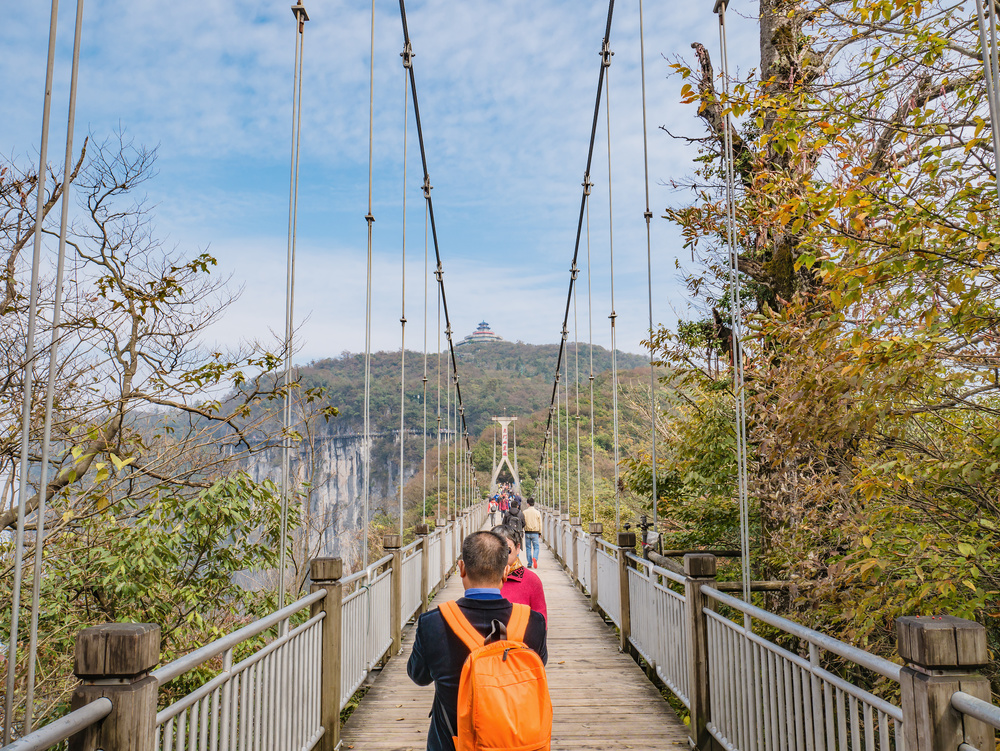
Local government figures show the growth isn't just about the famous pillars. Visitors are staying longer and spending more per head, drawn by the mix of national park hikes, the glass bridge and nearby minority-culture villages.
The second-tier wave: Yibin, Chongzuo, Ili
Beyond Zhangjiajie, travel platform Tuniu reported growing interest in Yibin in Sichuan, Chongzuo in Guangxi and the Ili Kazakh autonomous prefecture in Xinjiang.
Each has its own pull. Chongzuo draws Vietnamese visitors across the border; Ili attracts travelers from Kazakhstan and neighboring countries; Yibin is catching attention for its riverside old town and spicy cuisine. Spending data from Alipay shows the pattern clearly: Meishan in Sichuan, Heihe in Heilongjiang and Zhangjiajie were among the smaller destinations with the fastest growth in inbound payment spending during the combined holiday period — Meishan's spending surged more than 400 percent year on year.
Border cities benefit from proximity and established transport links: more than 90 percent of Heihe's inbound bookings come from Russia, while Chongzuo leans on Vietnamese visitors. But the social-media effect is spreading too — distinctive scenery and food put on camera travel faster than any brochure.
Why it matters for your next trip
For travelers who have done the big three, the payoff of going smaller is real: shorter queues, lower prices, and experiences that don't show up in every guidebook. Zhangjiajie's combination of national park scenery, glass bridge and Tujia minority villages works as a 3-4 day add-on to a Changsha or Guilin trip; Yibin pairs with Chengdu; Chongzuo connects easily from Nanning.
Practical notes:
- Getting around: High-speed rail now links most of these cities to major hubs — Zhangjiajie has direct trains to Changsha, Guilin and beyond; Yibin sits on the Chengdu-Guiyang corridor.
- Payments: Alipay and WeChat Pay are widely accepted even in small cities; international cards work at most hotels, big stations and tourist ticket offices.
- Language: Outside the big cities, English signage thins out. Translation apps and offline phrase sheets go a long way — locals are usually happy to help.
- When to go: Autumn (October-November) is peak for scenery cities like Zhangjiajie; border cities are best visited outside Chinese national holidays to avoid the domestic rush.
For international visitors, the 240-hour visa-free transit policy (57 countries, 65 ports) gives up to 10 days in China — enough for one big city plus one smaller one. ChinaPie keeps updating experience guides for both; we don't handle visa applications or bookings, so check official entry rules before you travel.
What to do next
把一座大城市与一座小众城市组合进同一行程:如长沙+张家界、成都+宜宾、南宁+崇左;利用 240 小时过境免签(57 国、65 口岸、最长 10 天)排入;小城预订门票和酒店前先确认国际卡与移动支付支持情况,国庆等中国长假避开国内人流高峰。
What may vary
各城市入境数据为 2026 年前 7 个月或假期期间统计口径,季节与节假日分布会带来波动;小众城市英文标识与支付覆盖面不一,出行前以当地最新信息为准。ChinaPie 不代办签证或预订。