
Guilin's 'Oriental Heritage Playground': The New China Travel Experience Where You Play Cuju, Weave Brocade and Race a Dragon Boat on Grass
Guilin, famous for its karst mountains, now has a second draw: an 'Oriental Heritage Playground' where visitors play cuju, weave Zhuang brocade, practise calligraphy and do tai chi in a single afternoon. It is the clearest sign yet that China Travel is moving from sightseeing to hands-on experience.
Key takeaway
桂林正在把散落各处的非遗项目打包成'游乐场式体验产品'——'东方非遗游乐场':旱地龙舟、蹴鞠、织壮锦、书法、八段锦一站式体验。人民日报(中国城市报)6-08 报道:5 月底 67 国近 2000 名国际旅游业高管受邀体验;背景为近 80 国免签、2025 免签入境 3008 万人次(+近 50%)、桂林 2025 入境过夜游客 162.27 万人次(全国前十)。携程宣布 5 年投 150 亿元推广入境游、目标引入 2 亿国际游客。行业判断:入境游正从'浅层打卡'转向'深度体验'。
Full report
The 'Oriental Heritage Playground' turning scattered crafts into one experience
Ask a foreign tourist what there is to see in China and the answer is easy: the Great Wall, the Forbidden City, Guilin's karst mountains. Ask what there is to do, and the answer used to be vaguer. Guilin is trying to change that.
In late May, nearly 2,000 international travel executives from 67 countries and regions were invited to Guilin for the "Oriental Heritage Playground" (东方非遗游乐场) — a day-long experience put together by Trip.com Group where scattered heritage activities appear as proper playground attractions: cuju (ancient Chinese football with a woven rattan ball), Zhuang brocade weaving, calligraphy, tai chi and even dry-land dragon boat racing.
The idea, as People's Daily's China City News put it, is that visitors no longer want to just watch the scenery — they want to become part of it.
Why 2,000 travel executives flew to Guilin to play
The timing was deliberate. China now offers visa-free entry to nearly 80 countries, and 30.08 million foreigners entered visa-free in 2025, up almost 50% year on year. Guilin itself received 1.62 million inbound overnight visitors in 2025, ranking among China's top ten destinations.
But getting people in is only half the job. "Inbound tourism is shifting from traditional sightseeing to deep cultural experience," says Zhang Jianbin, chief strategy officer of CTS Travel. Liu Haiqiu, who has run inbound agencies for over 20 years, puts it more bluntly: "The world's expectations of China have changed. Travelers are looking for social value, personal experiences and novelty — not shallow check-ins."
Swiss hotel executive Andy, who tried brocade weaving at the playground, said: "It's amazing — nothing like this exists in my country. After holding these threads that have been passed down for a thousand years, I can understand my Chinese guests much better." Brazilian travel professional Carlos Tadeu Cunha spent the afternoon posting photos and videos to recommend China to his friends: "Personal experience is essential to truly understanding China." An American travel blogger, after tai chi and calligraphy, called it "really cool" and "wonderful".
What's inside: five ways to go hands-on
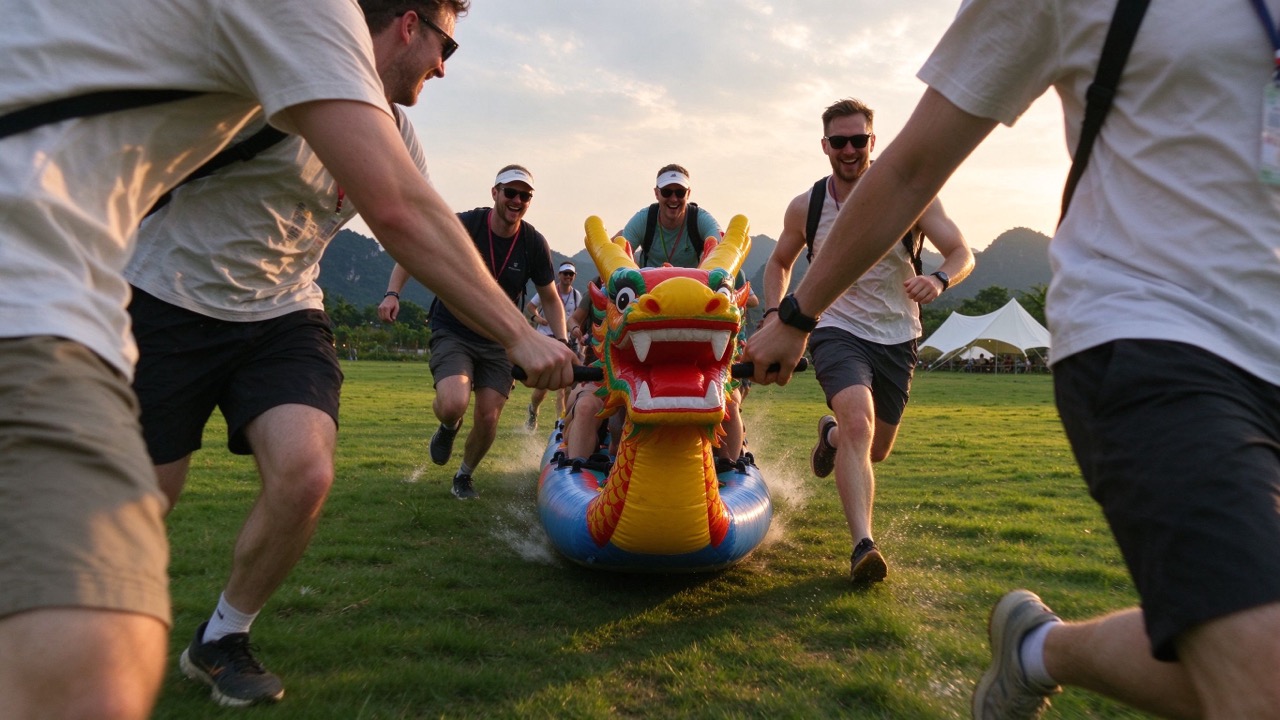
- Dry-land dragon boat racing — teams grab the inflatable boat by its dragon head and sprint across the lawn. No water required, maximum chaos.
- Cuju — kick a woven rattan ball the way players did over 2,000 years ago; the playground's foreign guests were lifting it with clean instep flicks.
- Zhuang brocade weaving — sit at a loom and thread colored yarn through the frame; slow, quiet, and the souvenir is a half-finished piece you made yourself.
- Calligraphy — a brush, a sheet of paper, and four characters like 桂林山水 ("Guilin's mountains and rivers").
- Tai chi (ba duan jin) — follow the slow eight-posture routine on the lawn; no experience needed.
Behind the scenes, Trip.com Group announced 15 billion yuan over five years to promote inbound travel to China, with a target of bringing 200 million international visitors. It has already opened 8,000-plus scenic areas to international travelers, deployed multilingual ticketing machines covering 280-plus sites, and helped 4.85 million foreign visitors buy high-speed rail tickets.
What this means for your next China Travel trip
For independent travelers, the takeaway is simple: heritage experiences are no longer scattered or hard to find — they are being packaged into bookable, one-day formats. In Guilin, the sample day looks like this: hike the Li River in the morning, spend the afternoon at a heritage playground (dry-land dragon boat, cuju, brocade, calligraphy, tai chi), then finish with an evening drone light show over the city.
Most of these activities cost little or nothing beyond entry to the venue — the kind of price-to-experience ratio that is hard to match elsewhere. Check chinapie.ai for Guilin and nearby heritage experience pages before you go.
What to do next
去桂林:上午漓江徒步,下午找非遗游乐场类体验(旱地龙舟/蹴鞠/织锦/书法/八段锦),晚上看无人机光影秀;这类活动多数只需场地门票、额外成本低;阳朔可搭配攀岩;出发前上 chinapie.ai 查桂林与周边体验页
What may vary
'东方非遗游乐场'是携程在 5 月国际旅游业高管活动中的策划呈现,日常固定场次与票价以当地/平台实际为准;免签 3008 万人次为 2025 全年口径,与 2026 年季度数据(如 Q3 外国人入境 1160.1 万)为不同统计周期;'卡洛斯''卡特(化名)'等为报道中受访者姓名