
China Travel, With a Cup of Coffee: Free Rongxiu Embroidery Experience at Shanghai's Lujiazui Coffee Festival
Shanghai's newest China travel experience: a red pavilion at the Lujiazui Coffee Festival where visitors stitch national-level rongxiu embroidery with professional embroiderers — free, and open only to October 25.
Key takeaway
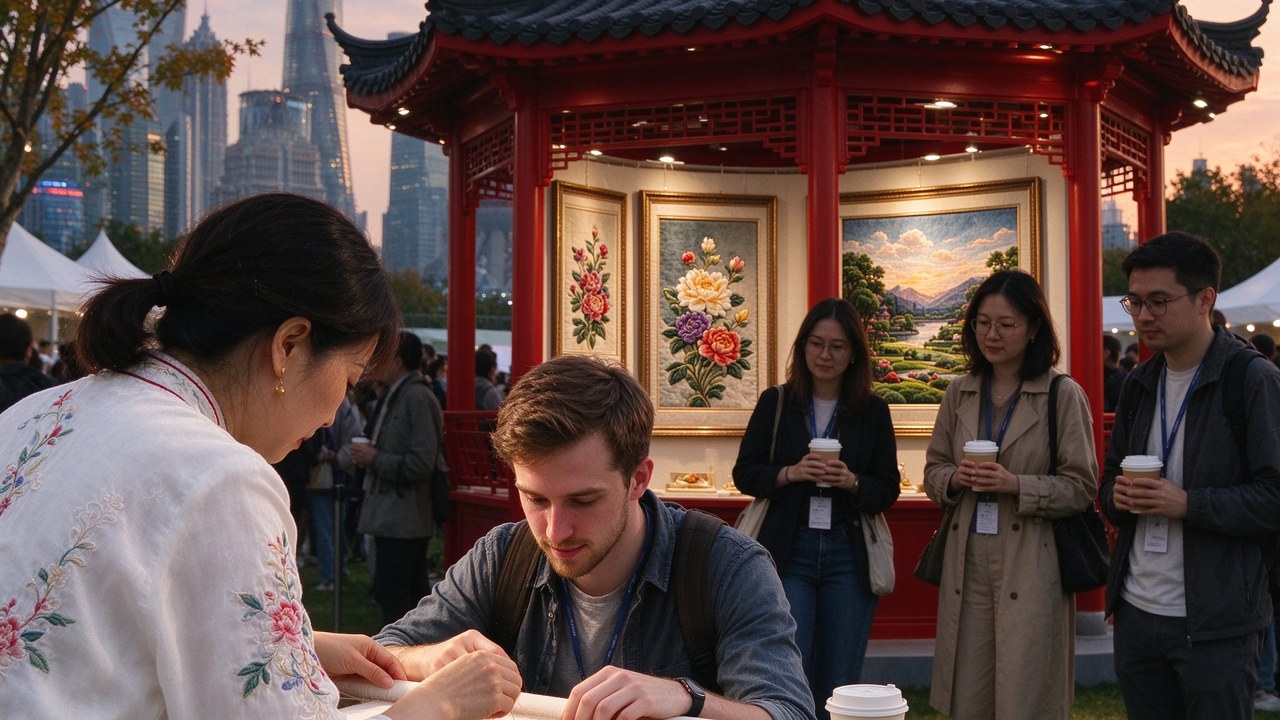
At the 11th Lujiazui International Coffee Festival (from Oct 19), the Pudong New Area Rongxiu Association has set up Ronghua Pavilion, a red octagonal pavilion on the Lujiazui Green showing 85 fine Shanghai rongxiu (national-level wool needle embroidery) works, with professional embroiderers guiding visitors hands-on and a coffee-festival themed co-creation piece. Free to visit, runs until Oct 25; a regular rongxiu experience zone at the Pudong New Area Cultural and Arts Guidance Center stays open by free appointment.
Full report
Coffee first, then a century-old needle.
This week, the newest thing to do in Shanghai doesn't involve a reservation, a membership, or even a ticket. It's a red octagonal pavilion on the lawn of the Lujiazui Green, where the 11th Lujiazui International Coffee Festival opened on October 19 — and where visitors are doing something you rarely see at a coffee festival: sitting down with a professional embroiderer and learning a national-level intangible heritage craft, free of charge.
The pavilion: 85 works, one red pavilion, a needle in your hand
The pop-up is called Ronghua Pavilion (绒华亭), a Chinese-red octagonal pavilion run by the Pudong New Area Rongxiu Association for its "Embroidery of Shanghai, Coffee of Pudong" show. Inside, 85 fine Shanghai rongxiu (wool needle-embroidery) works are displayed in miniature immersive scenes — a European-style parlor dressed in embroidered pieces, small vignettes of everyday life where "the window opens onto a view." Locals like to call the craft "the Eastern oil painting done with a needle."
What makes the pavilion worth crossing town for is the third element: association embroiderers are on site every day, guiding visitors hand by hand through real stitching on a wooden frame. There is also a collective art project — everyone is invited to add stitches to a rongxiu piece themed around the coffee festival, finished together with the embroiderers.
The story: two imports that both made Shanghai home
Rongxiu is a useful reminder that Chinese craftsmanship was never a closed door. The technique originated in Europe — colored wool yarn embroidered onto mesh linen — and arrived in Shanghai in the mid-19th century, where it merged with Chinese embroidery traditions and grew into the distinctly Shanghai (haipai) style you see today. Large classic rongxiu works hang in the Shanghai Hall of the Great Hall of the People. In 2011, the craft was inscribed on the national intangible cultural heritage list, with the Pudong New Area Rongxiu Association as its national-level safeguarding unit.
The festival pairing is deliberate, say organizers: coffee and rongxiu are both "things from abroad that put down roots in Shanghai." The pavilion is meant as a mobile cultural container — heritage that walks out of the museum hall and into an everyday urban scene.
How to try it (before October 25)
- Go to the Lujiazui Green — take Metro Line 2 to Lujiazui station and walk toward the riverside green; the red octagonal pavilion is hard to miss among the coffee stalls.
- Find the embroidery corner — the Ronghua Pavilion shows 85 works, but the part you want is the hands-on table where the embroiderers work.
- Sit down and stitch — visitors are invited to try the craft on site under professional guidance, free of charge, and to join the coffee-festival themed co-creation piece.
- Keep the date — the show runs with the festival until October 25. After that, the association's regular rongxiu experience zone at the Pudong New Area Cultural and Arts Guidance Center stays open by free appointment, for deeper multi-session learning with a professional embroiderer.
What to keep in mind
- The festival draws big crowds, especially on weekends; weekday late afternoons are calmer.
- On-site guidance is run by association embroiderers — table availability shifts during the day, so grab a spot when you see one.
- The free-appointment experience zone is at the Pudong New Area Cultural and Arts Guidance Center, not at the festival site — book it separately if you want the longer course.
- No ticket and no purchase required for the pavilion; bring a coffee if you want the full vibe.
Why this is the China travel experience to watch
It fits the wider shift in China travel: with 240-hour visa-free transit now covering 57 countries and unilateral visa-free entry for 50 nationalities, more visitors are dropping into Shanghai for a single day or a long weekend — and experiences like this are the point. Heritage with no distance, no barrier, no queue. Between sips of coffee, you can take home a stitch of Shanghai that no souvenir shop sells.
For more ways to turn an ordinary Shanghai afternoon into a China travel memory — a $4 barbershop haircut, hand-pulled noodles, or a local-life loop through the city's lanes — see our Shanghai local-life guide and the China barbershop experience guide.
What to do next
- Take Metro Line 2 to Lujiazui and walk to the Lujiazui Green; find the red octagonal Ronghua Pavilion among the coffee stalls. 2) Watch the 85-piece exhibition, then sit at the hands-on table and stitch under professional guidance — free. 3) Join the coffee-festival themed co-creation piece if you want a share in the finished artwork. 4) Visit before Oct 25 (weekday late afternoons are calmer). 5) For a deeper course, book the free appointment at the Pudong New Area Cultural and Arts Guidance Center's rongxiu experience zone. 6) Pair with other Shanghai local-life stops — see the Shanghai local-life guide and China barbershop experience on ChinaPie.
What may vary
Embroiderer-guided table availability shifts during festival hours, especially on weekends; festival dates and the pavilion's daily schedule are set by the organizer; the appointment-based experience zone has its own booking process separate from the festival.