
Shenzhen After Dark: Night Markets, Seafood Streets & the City That Never Switches Off — 22 Days to APEC 2026
With 22 days to APEC Shenzhen, the city's night markets and seafood streets are becoming a China Travel headline. A practical guide to eating, shopping and watching drones after dark.
Key takeaway
距 APEC 深圳系列活动启动(11-14 高官会)还有 22 天。深圳夜晚正成为 China Travel 的新看点:东门步行街人均约 85 元(约 12 美元)吃遍一条街、蛇口望海路海鲜街人均 150-300 元现选现做、八卦一路美食街改造后客流创十年新高;夜晚还有 1.2 万架无人机灯光秀与无人机送奶茶。240 小时过境免签 57 国,地铁拍国际卡、微信/支付宝一部手机搞定。
Full report
22 days to APEC Shenzhen 2026 — and the city's nights are quietly becoming one of the strongest reasons to visit.
APEC's final Senior Officials' Meeting opens in Shenzhen on November 14, followed by the CEO Summit (November 17-18) and the 33rd APEC Economic Leaders' Meeting (November 18-19). International media have already noticed that artificial intelligence is formally on this year's agenda — The Diplomat reported in October that roughly 1,000 business leaders are expected in the city, calling Shenzhen "Silicon Valley of the East" for its density of AI and robotics companies. But the same city that hosts the future during the day serves something far older at night: street food, seafood platters and neon-lit alleys, at prices that make a full evening feel like a bargain.
Three streets that tell Shenzhen's night story
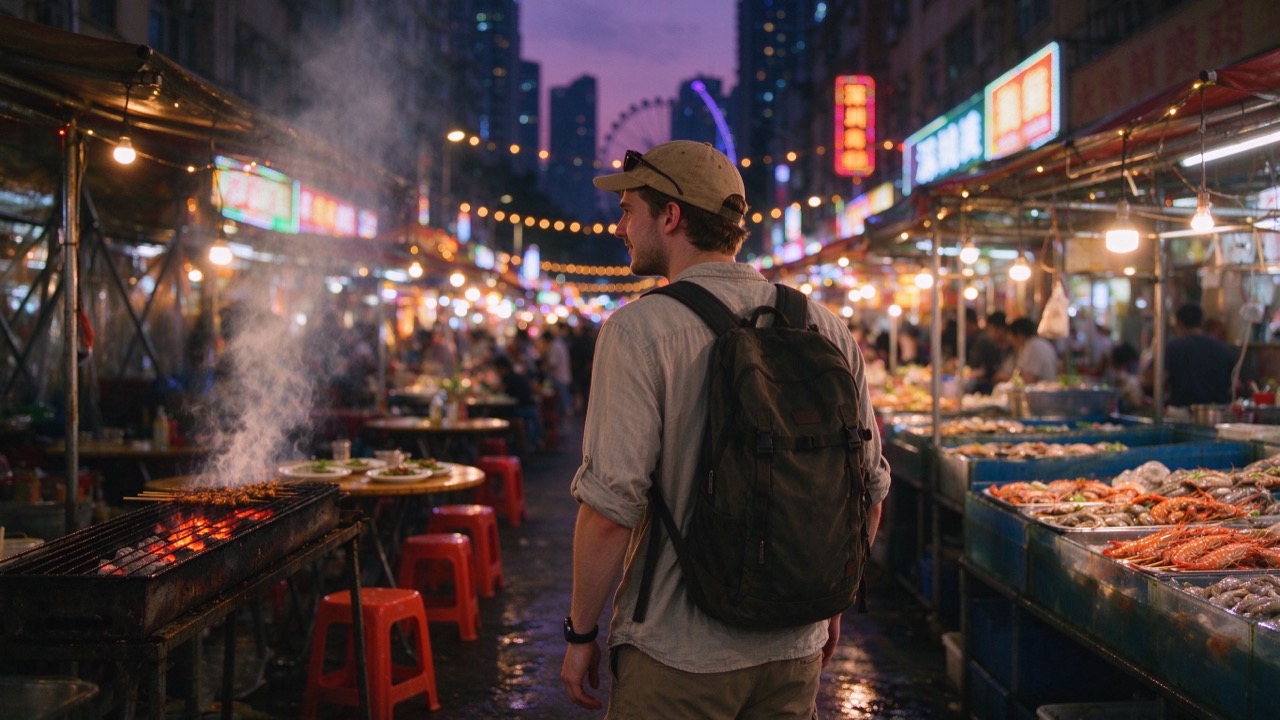
Start in Luohu at Dongmen Pedestrian Street (东门步行街), Shenzhen's oldest shopping district, where a food crawl costs roughly ¥85 (about $12). Street stalls run the national tour: grilled octopus tentacles (¥15), takoyaki (¥15 for six), Peking duck wraps (¥15 for five), strawberry-cream-cheese egg tarts (¥20) and mala skewers at ¥2 a piece. Add a Chaoshan beef hotpot — posted beef-delivery times and a 12-second swish are part of the ritual — and you have a proper Shenzhen dinner. Metro Line 1, Laojie station.
Then go south to Shekou (蛇口), Shenzhen's most foreigner-friendly corner and home of the 30-year-old Shekou seafood market. On Wanghai Road, a 300-metre stretch of open-air restaurants pulls from the same live tanks: king prawns around ¥150 a kilo, lobster around ¥400, oysters by the dozen for roughly ¥80. You point, they cook — steamed with ginger and scallion, stir-fried with black bean, or deep-fried with garlic and chilli. Budget ¥150-300 per person. Around the corner, 20-to-30-year-old shops still hold the neighbourhood's memory: Deiji siu mei, Jia Hua's handmade seafood zongzi, Baicaotang's sugar water.
Third, Bagua Yilu Food Street (八卦一路) in Futian — built in the 1980s, billed as Shenzhen's first food street. Its pavement renovation just finished, and the numbers are the story: shop revenue up 30% year on year, foot traffic at a decade high, and the district now labels itself an international-friendly block with bilingual menus and an English corner for residents. It is the rare case of an old street being fixed up and getting busier, not gentrified into silence.
Why Shenzhen nights feel like the future
Nightfall is when Shenzhen's two identities overlap. In October, a 12,000-drone light show over the city drew big crowds and, per state media, drove around ¥1.2 billion in associated tourism consumption that evening. Drone food delivery is routine enough that visitors watch a six-rotor aircraft lower bubble tea onto a park bench. Huaqiangbei's electronics bazaars stay open late, and with China's expanded tax-refund scheme — 18,000+ storefronts nationwide, claims up 3x this year — a night shopping run can come with the VAT back on your card.
This is the detail that surprises most first-time visitors: the future runs alongside street food, not instead of it. You can eat oyster omelettes under a lantern alley at Shuiwei, then walk out and see delivery drones crossing the skyline.
What it costs, and how you get around
A full night out — food crawl, seafood dinner, one drone show, metro home — lands around ¥150-300 per person, versus three or four times that for an equivalent night in most Western capitals. That is the ChinaPie pitch in practice: real experiences and strong emotion at one-fifth to one-tenth the price.
Practical entry notes: the 240-hour visa-free transit policy now covers 57 countries, so many travellers can add Shenzhen without a separate visa application. Metro gates accept foreign bank cards by tapping; one phone with WeChat Pay or Alipay covers stalls, restaurants and taxis. The new Huanggang checkpoint — the world's largest single-building land port, opening before APEC — cuts the Hong Kong-to-Shenzhen crossing to about five minutes.
The APEC angle, and what ChinaPie can't do
Shenzhen is using APEC week to show off both sides of itself: smart-city tech in the sessions, street-level energy after hours. The official APEC details come from apec2026.cn, China's Ministry of Foreign Affairs and Shenzhen Government Online — and ChinaPie does not handle visa, certificate or registration paperwork for anyone, so plan entry via official channels.
For the fuller Shenzhen story, watch the dedicated APEC Shenzhen topic page (coming soon) and, if you are pairing this with business travel, the Canton Fair page that is live now — two entry points into the same southern-China season. The countdown is on: 22 days to APEC Shenzhen.
What to do next
安排一晚深圳夜游:① 傍晚先到东门步行街小吃扫街(约 85 元吃饱);② 地铁转南山蛇口,望海路海鲜街现选现做一顿海鲜;③ 晚上看无人机灯光秀或欢乐港湾滨海夜景;④ 回程用 240 小时过境免签/新皇岗口岸 5 分钟回香港,详情关注 chinapie.ai APEC 深圳专题页与广交会专题页。
What may vary
夜市摊位与价格随季节和客流浮动,以现场为准;无人机灯光秀场次以官方公告为准;APEC 期间部分区域可能有临时管控;新皇岗口岸具体开通时间以官方为准;深圳政府在线称 APEC 周将新增 50+ 条公交地铁接驳线、公交运力 +20%,出行前可关注官方通告。