
China's $14 Foot Massage: 90 Minutes, Tea Included, No Tipping | ChinaPie
A 90-minute foot massage in China runs ¥98-198, about $14-28, with tea, fruit and a private room. The hotel spa upstairs charges ¥588 for sixty. Here is the full session, the booking routes, and how to tell a legitimate shop from a dodgy one.
Key takeaway
A standard 60-90 minute foot massage in China costs ¥98-198 (about $14-28) at legitimate chains, with tea, fruit and usually a private room included. Budget shops start near ¥68, upscale lounges reach ¥280, and hotel spas charge around ¥588 for 60 minutes. No tipping. Book by walking in, via Dianping/Meituan, or through your hotel front desk.
Read on
Ninety minutes. A bucket of hot herbal water, a recliner, a cup of tea, a plate of cut fruit, and someone who knows exactly where the arch of your foot connects to the back of your neck. In most Chinese cities this runs ¥98 to ¥198 — roughly $14 to $28. The hotel spa on the top floor of the same building charges ¥588 for sixty minutes.
That gap is not a discount promotion. It is a completely different business model, and it is the single best-value hour you can buy on a trip to China.
Why this is the experience nobody puts on a list
China travel content is saturated with the same six things: hanfu, hotpot, the high-speed rail, pandas, night markets, and the ear cleaning video that went viral. Foot massage rarely makes the list because it photographs badly. There is nothing to film. You are lying down.
But it is the experience travelers actually repeat. It costs less than dinner, it takes an evening you would otherwise spend on your phone, and it fixes the one problem every trip to China creates: you will walk further than you have walked in years. Twenty thousand steps a day is normal here. By day three your calves are stone and your feet have opinions.
What ninety minutes actually look like
The format is remarkably consistent across the country, which is part of why it works for visitors who do not speak Chinese.
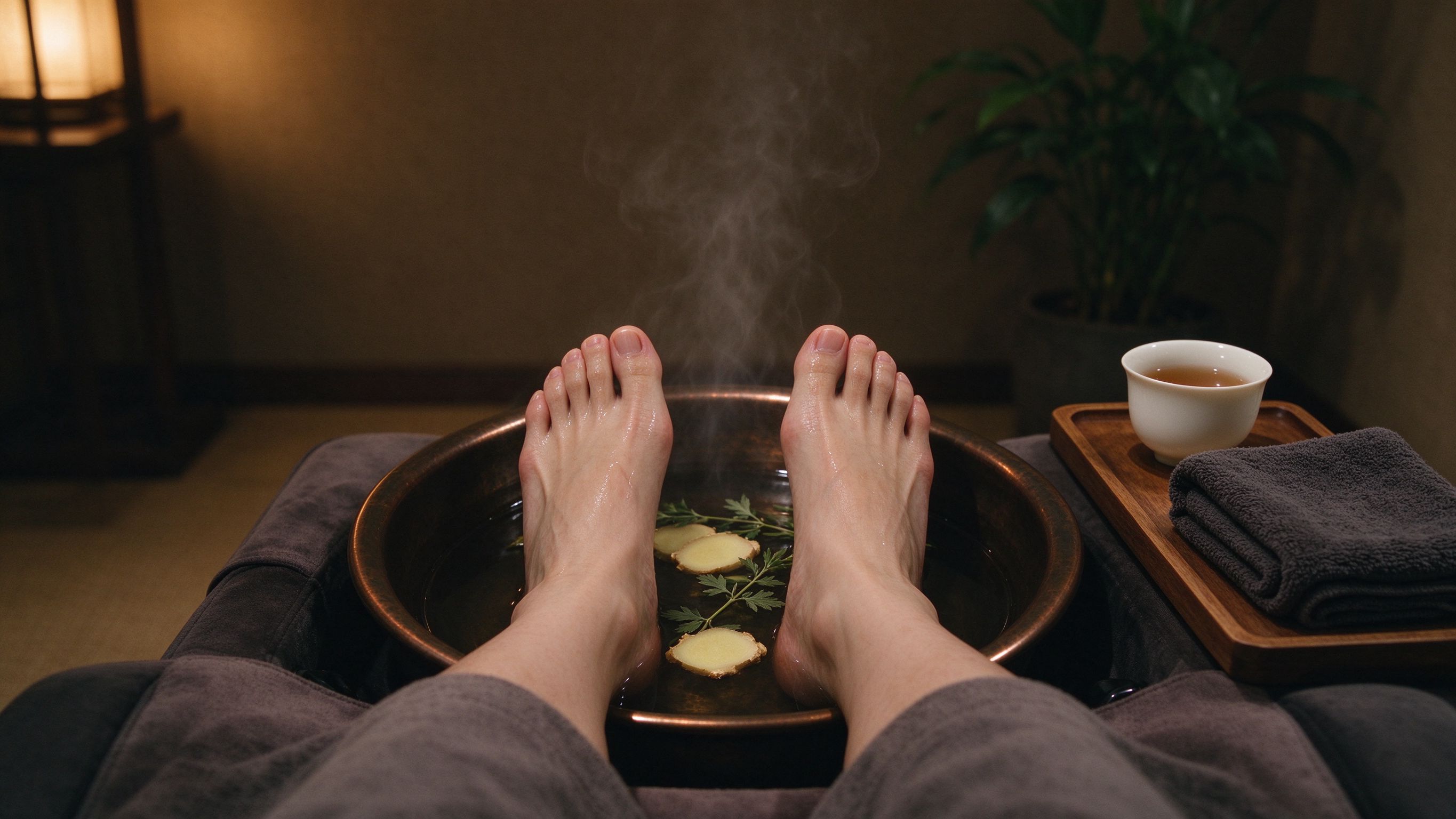
You walk in, take off your shoes, and get handed slippers. In a chain shop you are usually shown to a recliner in a shared lounge; in a slightly nicer place you get a private room with a television nobody turns on. A staff member brings a basin of water — often with herbs, ginger, or something milky that smells like medicine — and your feet soak for ten to fifteen minutes while you drink tea.
Then the session splits into three parts. The first fifteen to twenty-five minutes go to your shoulders, neck, and upper back, which is where most desk workers carry their tension and where most travelers discover they have been hunching over a suitcase. Then comes the foot work: thumbs, knuckles, and occasionally an elbow, moving along the sole, the arch, the heel, and the outside edge, pausing on the spots that make you flinch. It finishes with a hot towel, a calf stretch, and sometimes a cup of ginger tea on the way out.
A 70-minute session in Chongqing's 24-hour spas is often structured exactly like this: 25 minutes of shoulder, neck, and back meridian work, then 35 minutes of reflexology, for ¥149 — about $22. A nationwide chain does a 70-minute ginger foot treatment for ¥90 to ¥100 and an 80-minute meridian version for around ¥110.
The part that hurts, and why you should let it
Chinese foot massage is not a gentle rub. On the arch and the heel, the pressure can be sharp enough that you instinctively pull your leg back. The therapist will ask 力度可以吗 — "is the pressure okay?" — and will adjust if you say 轻一点 (lighter).
Here is the honest framing: the reflexology map that links each spot on your foot to a specific organ is traditional Chinese medicine theory, not established clinical fact. What is well documented is the effect on the things you actually feel — tight calves, stiff shoulders, swollen feet after a long flight, and the specific kind of sleep that follows an hour of being physically worked on. Go for that. Do not expect it to fix your liver.
If you are ticklish, say so at the start; therapists deal with it constantly and will switch to firmer, slower strokes. If you have a foot injury, diabetes, varicose veins, or are pregnant, get medical advice first — this is pressure work, not a neutral bath.
What you are paying, and where the tiers sit
Prices published in 2026 by Shanghai-based guides put a standard foot massage at ¥98 to ¥198 for 60 to 90 minutes at a legitimate chain. Budget spots start around ¥68. Upscale lounges run to about ¥280. Hotel spas are their own universe: ¥588 for 60 minutes at a resort spa is normal, and you are paying for marble, not technique.
The practical implication is simple: the ¥100 shop and the ¥588 spa are often using the same trained hands. What changes is the room, the tea, and how much English is spoken at reception.
Tipping is not expected. The price on the menu is the price. If someone quotes you a number at the door and then a different number at the counter, leave.
| Tier | What you get | Price |
|---|---|---|
| Budget neighborhood shop | 60 min, shared lounge, basic tea | from ¥68 |
| Legit chain (most cities) | 60–90 min, tea, fruit, recliner | ¥98–198 |
| Upscale lounge | 90 min, private room, ginger tea | up to ¥280 |
| Hotel spa | 60 min, marble, silence | around ¥588 |
How to book without a Chinese app
Three routes, in order of how well they work for a short visit.
The first is walk-in. Outside weekend evenings, most neighborhood shops have availability. This is the route for anyone who does not want to install another app before dinner.
The second is Dianping (大众点评) or Meituan, the two platforms that carry shop listings, prices, photos, and reviews. You can browse without an account; booking usually needs a Chinese phone number, which is why many visitors use the shop's phone number and simply call, or ask their hotel front desk to book.
The third is your hotel. Concierge desks in Chengdu, Chongqing, and Shanghai arrange this daily and will pick a place where the staff is used to foreigners.
If you book online, check the session length and what is included — 60 versus 90 minutes, private room or lounge, and whether the listed price covers both feet (it almost always does).
What to say when you walk in
You do not need much language. Show the shop's listing on your phone with the price and duration, and say the number of minutes you want. For pressure, 轻一点 means lighter and 重一点 means firmer. If you want a private room, 包间 (bāojiān) is the word. If you are paying by card, ask 可以刷卡吗 before you start — larger chains accept foreign cards and Alipay, smaller shops may be cash or QR only.
Bring socks you do not mind wearing afterwards. Bring your passport only if you are paying with a foreign card that requires ID matching; most shops do not ask.
How to tell a legitimate place from a dodgy one
Four signals, and they are boring on purpose.
A printed price list at the counter, with session lengths attached. Staff in uniform, working in a lit room with a window or an open door. Reviews on Dianping that talk about pressure and technique rather than anything else. And no upselling of "special" services — a legitimate shop sells minutes, tea, and maybe a foot scraping add-on, and stops there.
If a place has no price list, no reviews, blacked-out windows, and a man at the door quoting a price that changes, walk out. The good news is that this is the exception, not the norm; foot massage is a mainstream, family-friendly, entirely ordinary thing to do on a Tuesday night in China, and most shops are exactly what they look like.
Where it fits in your day
The best slot is the end of the day, after the night market and before the hotel. Shops in major cities commonly run until midnight, and the 24-hour ones — Chongqing has several — exist precisely for people who finished dinner at eleven.
It also works as a rain plan, a jet-lag plan, and a recovery plan after a hiking day. Two hours before a flight is a genuinely good use of a gap: you arrive at the airport with your calves no longer angry.
One warning: do not schedule it right before a long walk you care about. The first twenty minutes after you stand up, your feet feel like someone else's, and it takes a few blocks to trust them again.
The math
Take the mid-range: 90 minutes, tea, fruit, a private room, ¥150. That is about $21 at current rates. A single museum ticket in Europe costs more. A one-hour hotel spa session in China costs three to four times as much and is not better at the actual massage.
This is the pattern that runs through almost every experience on ChinaPie: the thing locals do on a normal evening is priced for locals, and it is better than the version sold to tourists. Foot massage is the clearest example of it, because there is no tourist version. There is just the shop around the corner, a basin of hot water, and an hour where nobody needs anything from you.
If you are building an itinerary around experiences rather than landmarks, start here — and build the rest of the evening around it, not the other way around. ChinaPie's experience desk lists foot massage and similar local bookings city by city: https://chinapie.ai/experiences/