
China Travel: Quanzhou's Xunpu Village Sells a $6 Flower Crown
Xunpu, a fishing village outside Quanzhou, will pin a kilo of jasmine and chrysanthemum around your bun for ¥40. Here is what the price covers, where the studios mark it up, and how to visit without turning a working village into a backdrop.
Key takeaway
Xunpu village in Quanzhou charges ¥40 for a fresh-flower headdress, a braided bun and a costume, a 30-40 minute appointment you can wear all day. Entry to the village is free; photo studios that add makeup, a photographer and edited frames charge ¥150-300.
Read on
A ¥40 note, about US$5.60, buys a fresh-flower headdress in Xunpu. That is the entire pitch, and it is why the lane outside the Mazu temple is already full of people in rented tunics at nine in the morning.
Xunpu is a fishing village about seven kilometres east of Quanzhou's old town, on the south bank of the Luoyang River where it widens toward the sea. Women here have worn flowers in their hair for generations; in 2008 the custom went onto the second national list of intangible cultural heritage. At the end of 2023 the look went viral. The village now has close to 300 photo studios and around 20,000 visitors on an ordinary day.
What ¥40 actually buys
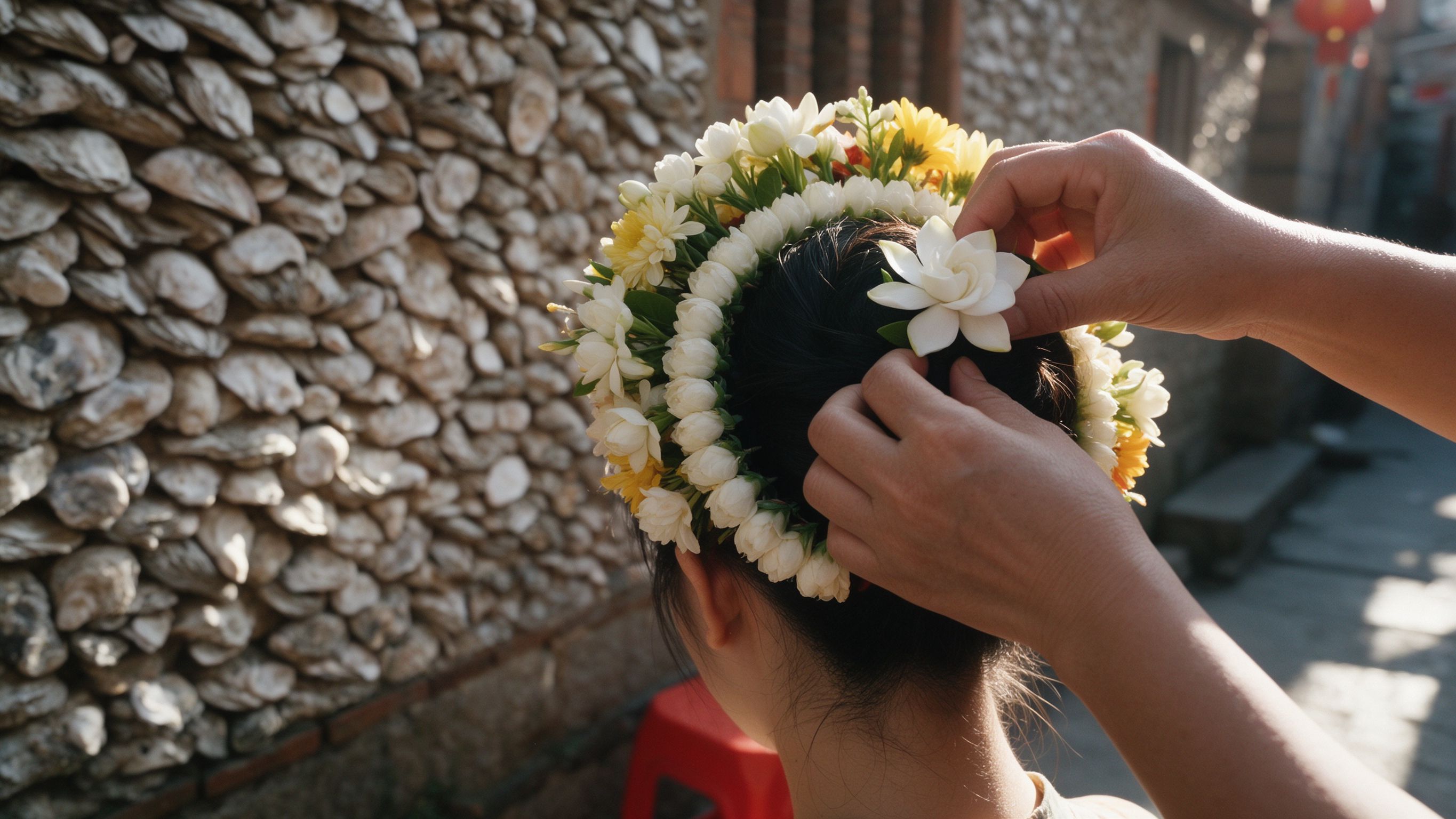
A seat in a plastic chair for 30 to 40 minutes, a braided bun, and a wreath of fresh jasmine, chrysanthemum and gardenia pinned around it — one to three kilos of flowers depending on how generous the shop is. The price includes one or two costumes, usually a minnan tunic or a hanfu. You keep it on for the rest of the day, and nobody minds if you eat lunch in it.
Two details matter. The ¥40 is the village standard for the basic set, not an opening bid; a shop quoting more for the same package is charging a tourist premium, and the next door usually sells it at the standard price. And the flowers are real, so the wreath looks best in the first two hours and softens by late afternoon.
The village around the headdress
The headdress is why people come; the setting is why it photographs so well. The lanes behind the temple are lined with oyster-shell houses, walls built from shells roughly 15 to 20 centimetres long set into rammed earth — a local answer to salt air and a lack of brick. The Mazu temple at the entrance, Shunji Palace, is where residents still burn incense in the morning.
This is also a working neighbourhood, not a set. Women in their fifties and sixties walk past with flowers in their own hair while a queue forms behind them. On a public holiday, that same 800-metre loop fills up. Over the National Day break in October, the village logged 493,700 visits.
The markup to avoid
Photo studios are the expensive part. Makeup, a photographer and five to ten retouched frames run ¥150 to ¥300. On a budget, pay ¥40 at a small salon, shoot in the lanes with your own phone, and spend the difference on lunch. If you do book a studio, ask in writing what is included: editing, frame count, and whether costume changes are unlimited.
How to get there, and when to go
There is no metro to Xunpu. Bus 8 from the old town reaches Xunpu village stop in 25 to 35 minutes for ¥2; the air-conditioned K301 runs the same corridor for about ¥3. A DiDi from Quanzhou railway station takes 25 minutes and ¥22 to ¥30. From Xiamen, the high-speed train is about 30 minutes and ¥30 to ¥45, then a 20-minute car ride.
Go early. Shops open around 08:30, and eastern light hits the oyster-shell walls between nine and ten; by eleven the lanes are busy and the sun is flat. October to April is the comfortable window — summer here runs 30-35°C with typhoon-season downpours. A Tuesday morning is a different village from a Saturday.
The etiquette locals notice
Ask before photographing a woman in her own headdress. "可以拍张吗?" — may I take a photo — is enough, and a ¥10 to ¥20 tip is welcome but not required. Do not block a lane for a shot.
It helps to know where the money goes. Most shops are family-run, and more than nine in ten of the people doing the hair are women from the village, according to the municipal heritage office. Paying ¥40 at a local salon keeps that intact in a way that paying an outside studio does not.
What to eat, and what to skip
Walk to the eastern end near the seawall for lunch. Oyster omelette, hao la, is about ¥25; steamed oysters run ¥30 to ¥50 a dozen; sea snails are ¥40 to ¥80. Toilets are basic and cost ¥2 to ¥5, so carry tissues. There is no English signage; a screenshot of 蟳埔村 solves most communication problems.
Skip the mid-afternoon visit if you care about photographs, and skip the plastic flowers sold at the entrance. Stay past five and the marsh behind the seawall fills with egrets.
If you are building a Fujian trip around this, ChinaPie's guides cover Quanzhou transport, food and the rest of the old town at https://chinapie.ai/ .
What to do next
Take bus 8 from the old town to Xunpu village stop, arrive before 10:00, and pay ¥40 at a small family salon rather than a photo studio. Ask before photographing residents, keep a screenshot of 蟳埔村 for drivers, and eat at the eastern end near the seawall before returning to Quanzhou for the old town in the late afternoon.
What may vary
Salon prices and studio packages vary by shop and season, and peak dates such as the National Day break can quadruple foot traffic. The village is a residential area: shops may close without notice, and heavy rain or typhoon warnings can shut the lanes for a day.