
How to Plan a Realistic China Itinerary
Plan a realistic China itinerary: pick one geographic region, use a 2-night minimum per city, account for 6–7h door-to-door transfer times, and leave buffer days for payment and app setup. The #1 mistake is packing too many cities — here's how to avoid it.
Key takeaway
Group cities by geographic region, use a 2-night minimum per city, account for 5–7 hours of door-to-door transfer time between major cities, and leave buffer days for digital setup. A 14-day first trip should cover at most 3 base cities plus day trips.
Full guide
Why itinerary planning in China is different
China is not Europe. In Europe, you can visit three countries in a week because distances are short and infrastructure is tourist-calibrated. In China:
- Distance is deceptive. Xi'an to Chengdu is ~3.5 hours by high-speed rail — comparable to London to Edinburgh. Beijing to Shanghai is ~4.5 hours — like Paris to Berlin.
- Station ≠ city center. Beijing South Railway Station is ~30 minutes from the Forbidden City area. Shanghai Hongqiao is ~45 minutes from the Bund. If your itinerary says "train at 10am, arrive at 2pm," you're really losing 9am–4pm.
- Digital friction is real. Even with everything set up, your first Alipay scan, first DiDi ride, and first Amap navigation will take longer than expected. Budget 30–60 extra minutes per "first time" per day.
- Reservation systems don't speak English. Key attractions (Forbidden City: dpm.org.cn, National Museum: chnmuseum.cn) only have Chinese-language booking portals. You'll need translation tools or a friend.
Step 1: Pick a region, not a checklist
The most successful first-time China trips focus on one geographic region and go deep, not wide. China has four natural travel corridors:
The Golden Triangle (Classic First Trip)
Beijing → Xi'an → Shanghai (10–14 days)
- Beijing (4–5 days): Forbidden City, Great Wall, Summer Palace, Hutongs
- Xi'an (2–3 days): Terracotta Warriors, City Wall, Muslim Quarter
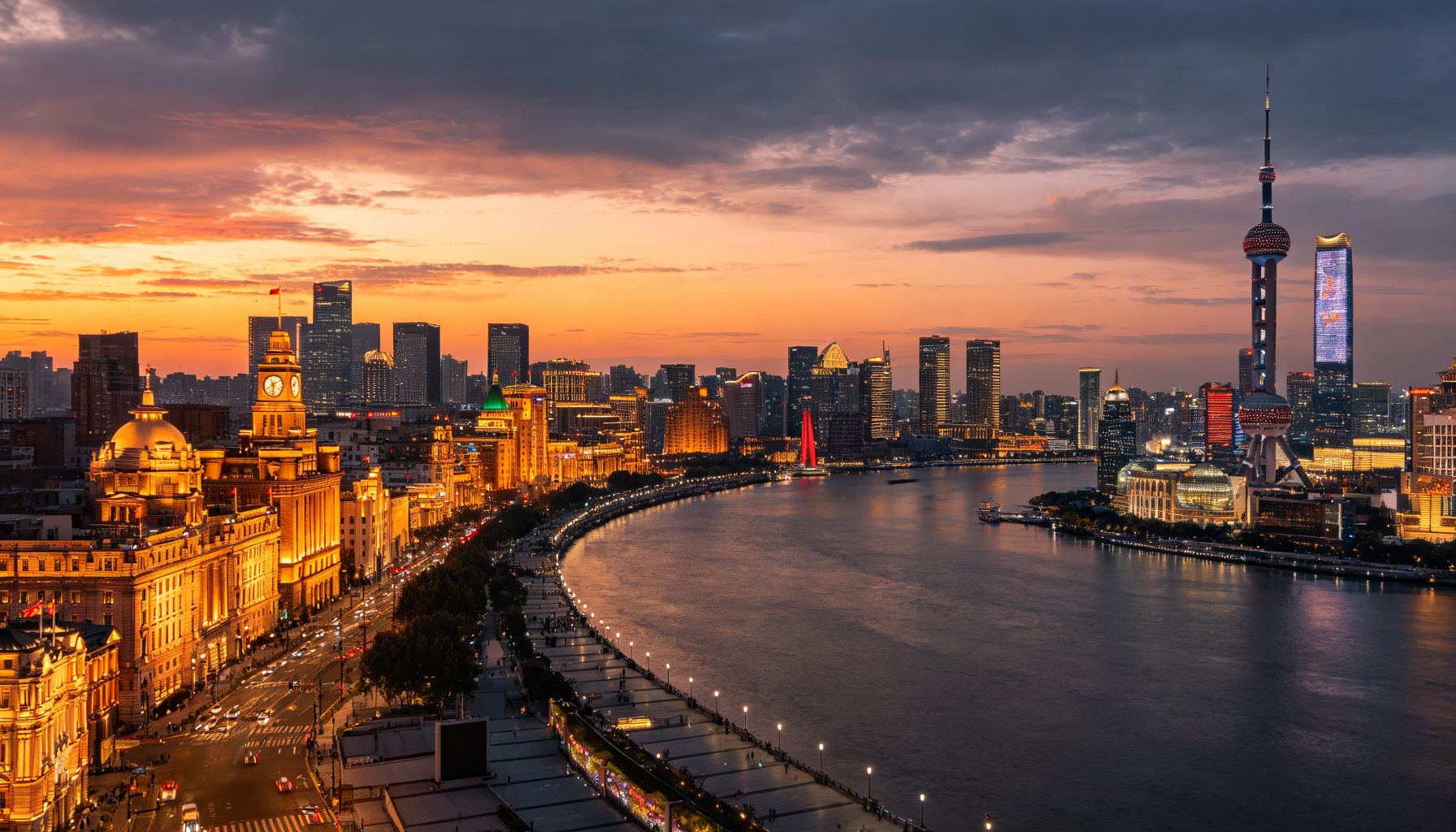
- Shanghai (3–4 days): The Bund, French Concession, day trips to Suzhou or Hangzhou
Transfer: Beijing→Xi'an ~4.5h train; Xi'an→Shanghai ~6h train (or fly 2.5h).
The Southern Circuit (Warm & Modern)
Guangzhou → Shenzhen → Hong Kong (8–10 days)
- Guangzhou (2–3 days): Canton Tower, Shamian Island, dim sum
- Shenzhen (2–3 days): Futian CBD, Huaqiangbei electronics market, Shekou waterfront
- Hong Kong (3–4 days): Victoria Peak, street markets, day trips to outlying islands
Transfer: Guangzhou→Shenzhen ~30min train; Shenzhen→HK ~14–18min high-speed rail.
The Natural Sichuan Loop (Food & Mountains)
Chengdu → Chongqing → Yangtze River area (10–12 days)
- Chengdu (3–4 days): Panda base, Sichuan opera, Jinli Ancient Street, day trip to Leshan Giant Buddha
- Chongqing (2–3 days): Mountain city views, hot pot, Yangtze River cable car
- Zhangjiajie or Jiuzhaigou (2–3 days): Avatar mountains or turquoise lakes
The Eastern Comfort Zone (Soft Landing)
Shanghai → Hangzhou → Suzhou (7–9 days)
- Shanghai (3–4 days): Bund, museums, day trip to a water town
- Hangzhou (2–3 days): West Lake, tea plantations, Lingyin Temple
- Suzhou (1–2 days): Classical gardens, canals, silk museum
Transfer: Shanghai→Hangzhou ~1h train; Hangzhou→Suzhou ~1.5h train.
⚠️ The "Grand Tour" trap: A 14-day trip covering Beijing, Xi'an, Chengdu, Guilin, Shanghai, and Hong Kong is not realistic. You'll spend 40% of your trip in transit and remember train stations more than destinations. Each city in this list needs at minimum 2 full days — doing the math, a 6-city trip needs 18+ days before accounting for transfers.
Step 2: Use the "2-night minimum" rule
For every city on your itinerary, ask: do I have at least 2 nights here?
Why 2 nights is the floor:
| Nights per city | What you actually get |
|---|---|
| 0 nights (day trip only) | ~4–6 usable hours after transit. OK for nearby small cities (Suzhou from Shanghai, Macau from HK). |
| 1 night | ~1.5 days including arrival and departure. You see one major attraction. Often feels rushed. |
| 2 nights | ~2 full days. You can do one major attraction + one neighborhood exploration. Minimum for cities with 2+ major draws. |
| 3–4 nights | Enough to settle in, see highlights, and have a "discovery day." Recommended for Beijing, Shanghai, Chengdu. |
Reddit's verdict on one-night stays: Threads like "Is my China itinerary realistic?" overwhelmingly receive the same feedback: "cut one city and add nights to the others." One-night hops in China are especially punishing because station transfers, check-in delays, and digital re-orientation eat half the usable day.
Step 3: Account for real transfer times
Here's what door-to-door travel between popular city pairs actually looks like:
| Route | Train time | Station→city | Check-in buffer | Real door-to-door |
|---|---|---|---|---|
| Beijing → Xi'an | 4h 30m | 30+30 min | 1h | ~6h 30m |
| Xi'an → Chengdu | 3h 30m | 25+30 min | 1h | ~5h 30m |
| Shanghai → Hangzhou | 1h | 45+20 min | 30 min | ~2h 30m |
| Guangzhou → Shenzhen | 30 min | 25+30 min | 30 min | ~2h |
| Chengdu → Chongqing | 1h 30m | 30+30 min | 45 min | ~3h 15m |
| Beijing → Shanghai | 4h 30m | 30+45 min | 1h | ~6h 45m |
How to use this table: If your itinerary says "Day 4: train from Beijing to Xi'an, visit Terracotta Warriors," this is almost certainly impossible. The Warriors close by 5:30pm and are 40km from Xi'an North Station. A 9am Beijing departure realistically gets you to Xi'an city center at 3:30pm — too late for the Warriors. Always allocate a full day for city-to-city transitions that take over 4 hours door-to-door.
When to fly instead: For routes over 5 hours by train (Beijing→Guangzhou, Shanghai→Chengdu, Xi'an→Guilin), a 2.5-hour flight may save a full day — but add 2 hours for airport security and baggage.
Step 4: Build in buffer and rest days
Digital setup buffer (Day 1–2): Your first 24–48 hours in China involve more friction than in most countries:
- Alipay/WeChat Pay binding: scan passport, verify identity (may need retry)
- eSIM activation or VPN testing: some eSIMs take 30–60 min to provision
- Navigation app orientation: Amap or Apple Maps feels different from Google Maps
- First DiDi ride: address input, pickup point negotiation
Budget at least one light day after arrival before tackling a timed ticket (e.g., don't book a 9am Forbidden City slot on your Day 1).
Scheduled rest days: For trips longer than 7 days, add one "nothing scheduled" day every 4–5 days. Use it to:
- Recharge from digital fatigue
- Explore a neighborhood you discovered
- Handle unexpected problems (card blocked, eSIM expired, rain cancels outdoor plans)
- Re-pack for the next leg
Step 5: Group attractions by district
Within each city, cluster your attractions geographically to minimize cross-city travel:
- Beijing: Day 1 = Forbidden City + Jingshan Park + Tiananmen (central cluster). Day 2 = Great Wall (full day, any section). Day 3 = Summer Palace + Olympic area (northwest).
- Shanghai: Day 1 = The Bund + Nanjing Road + Yu Garden (Puxi cluster). Day 2 = French Concession + Former French Concession + Xintiandi. Day 3 = Pudong + Shanghai Tower + day trip to water town.
- Xi'an: Day 1 = City Wall + Muslim Quarter + Bell Tower (city center). Day 2 = Terracotta Warriors (full day, 40km east).
This clustering reduces transit time and lets you walk between nearby attractions, which is both efficient and a better way to experience the city.
Who this is for
International visitors planning a first or second trip to mainland China who want a practical, step-by-step planning method — especially those who have seen ambitious multi-city social media itineraries and want to know what's actually realistic.
How to do it
Pick one geographic region (Golden Triangle, Southern Circuit, Sichuan Loop, or Eastern Corridor) rather than scattering cities across the map
Apply the 2-night minimum rule — every city on your itinerary must have at least 2 nights, or be a day trip from a nearby base city
Calculate real door-to-door transfer times using the table in this guide — a 4.5h train is actually 6–7h with station transfers and check-in
Allocate a full travel day for any city-to-city transition over 4 hours — do not book timed attraction tickets on the same day as a long transfer
Build in a light first day for digital setup (Alipay binding, eSIM activation, Amap orientation) before relying on timed reservations
Add one flexible/buffer day every 5 days for weather, illness, payment failures, or spontaneous discoveries
Group attractions by district within each city to minimize cross-city transit and maximize walking time
Book exit transportation first, then work backwards to plan the full itinerary — prevents ending up far from your departure airport
Watch for
Packing 5+ cities into a 10-day trip — this is the #1 planning mistake on Reddit and results in spending 40%+ of the trip in transit rather than exploring
Booking timed attraction tickets (Forbidden City 8:30am entry, Terracotta Warriors) on the same day as a long train journey — you will miss one of them
Assuming Google Maps works in mainland China — GPS offset makes it unreliable; pre-install Amap (高德地图) or use Apple Maps which calls Amap data
Waiting until arrival to set up Alipay or WeChat Pay — passport verification can take time and may require retries; do this 3–5 days before departure
Not saving hotel names and addresses in Chinese characters — DiDi drivers and front desk staff may not read English; keep screenshots on your phone
Relying on one payment method — carry at least one backup (second payment app or RMB cash ¥500–¥1000)
Forgetting that major attractions require advance booking — Forbidden City needs 7-day reservation via dpm.org.cn (Chinese only), closed Mondays
Not building a flexible day into the itinerary — one buffer day can save the entire trip from cascading problems when something goes wrong
What may vary
Visa requirements depend on nationality — 38+ countries have unilateral visa-free access (30 days) as of mid-2026, but always verify on the National Immigration Administration website. The 240-hour transit visa-free policy requires a third-country onward ticket (A→China→B, not A→China→A). High-speed rail schedules change seasonally. Attraction reservation windows can shift (Forbidden City has varied between 7–10 days). Payment app foreign card policies evolve — check official app announcements before departure.
Backup plan
If your primary itinerary breaks: (1) Missed train — go to the manual ticket counter (人工窗口) for rebooking; foreigners cannot use self-service machines. (2) Sold-out attraction — check Trip.com for guided tours with reserved ticket allocations, or pivot to a nearby secondary attraction. (3) Payment failure — switch backup app (WeChat Pay ↔ Alipay), use cash at hotels and chain stores. (4) Lost internet — use pre-downloaded offline Amap maps; hotel lobbies and shopping malls have free WiFi.
FAQ
How many cities can I realistically visit in 2 weeks?
Three base cities plus day trips is the sweet spot. Four cities is possible if distances are short (e.g., Shanghai–Hangzhou–Suzhou corridor), but you'll feel rushed. Five or more in 14 days is a Reddit cautionary tale.
Should I fly or take the train between cities?
For routes under 5 hours, high-speed rail is better — no airport transfers, security, or baggage delays. For routes over 5 hours (Beijing–Guangzhou, Shanghai–Chengdu), a 2.5-hour flight saves a full day. Morning domestic flights are frequent and generally on time.
Do I need a visa for every city on my itinerary?
If you qualify for visa-free entry (38+ nationalities as of mid-2026), you can visit most cities. However, Tibet (Lhasa) requires a separate Tibet Travel Permit even for visa-free nationals. Some border areas have additional restrictions. Always verify on the National Immigration Administration website.
What's the minimum time I need in Beijing/Shanghai?
Beijing: 3–4 full days minimum (Forbidden City, Great Wall, Summer Palace, one neighborhood). Shanghai: 2–3 full days (Bund area, French Concession, one day trip). Less than this and you'll leave feeling you missed half the city.
Is it realistic to do day trips from Shanghai to Hangzhou or Suzhou?
Yes — both are ~1 hour by high-speed train. A well-planned day trip works: leave by 8am, return by 8pm. But overnight stays let you experience evening atmosphere (West Lake at sunset, Suzhou canals lit up), which is a big part of the experience.
What's the biggest itinerary planning mistake first-timers make?
Treating China like a country you can 'check off' in one trip. China is continent-sized. Plan as if you will return — focus on one region and do it well. Travelers who slow down enjoy China far more than those who try to see everything.
What's the biggest mistake first-timers make with itinerary planning?
Treating China like a country you can "check off" in one trip. China is a continent-sized destination. Plan your trip as if you **will return** — focus on one region and do it well. The travelers who enjoy China most are those who slow down, not those who try to see everything.