
Quanzhou Travel Guide 2026: China's Maritime Silk Road City, Walked Slowly
Quanzhou is China's maritime Silk Road city: 22 UNESCO sites, a 1,000-year-old mosque, oyster-shell villages and a two-day route that actually works.
Key takeaway
Quanzhou, inscribed by UNESCO in 2021 for its Song-Yuan maritime trade port, is 17 to 19 minutes from Xiamen North by high-speed rail. Two days covers the walkable old town (Kaiyuan Temple, Qingjing Mosque, Tianhou Gong), Luoyang Bridge and the oyster-shell village of Xunpu. Most major sites are free; allow 600 to 1,000 yuan per person for two days excluding travel to Fujian.
Full guide
Most travellers route through Fujian on the way from Shanghai to Guangdong, spend a night in Xiamen, and never realise that the real maritime city is forty minutes inland. Quanzhou is where the Silk Road met the sea — not as a reconstructed attraction, but as a working town of 8 million people whose bus routes still run past fourteenth-century mosques.
Why Quanzhou deserves more than a day trip
In July 2021, at the 44th session of the World Heritage Committee in Fuzhou, UNESCO inscribed "Quanzhou: Emporium of the World in Song-Yuan China" onto the World Heritage List. It covers 22 component sites and became China's 56th World Heritage entry. The citation is unusually specific: this was the port that carried most of China's export trade during the Song and Yuan dynasties.
For roughly four centuries, from the tenth to the fourteenth, the city was known across the Indian Ocean as Zayton — the name comes from the Chinese word for the coral trees that grew around the harbour. Arab, Persian, Indian and Southeast Asian merchants settled here in numbers. Ibn Battuta passed through in the 1340s and described a port packed with larger ships than he had seen anywhere else. Marco Polo's account, whatever its accuracy, put the city on European maps.
What that history left behind is a rare kind of density. Within one walkable old town you can stand in a Buddhist temple founded in 686, cross the street to one of China's oldest mosques, built in 1009, and end the afternoon in the oldest and best-preserved Mazu temple in the country. A short drive out of town takes you to a Song-dynasty stone bridge still in daily use and a fishing village where women wear flower crowns that were listed as national intangible heritage in 2008.
Quanzhou also happens to be cheap. A day here costs a fraction of a day in Shanghai, and the food is arguably better.
Getting there: Xiamen is closer than you think
The Fujian coastal high-speed line opened on 28 September 2023, designed for 350 km/h, and it collapsed the Xiamen-Quanzhou trip into something you can do between breakfast and lunch.
- Xiamen North to Quanzhou South: 17 to 19 minutes, second class around 25 to 32 yuan.
- Xiamen North to Quanzhou station: 26 to 33 minutes, roughly 25 to 32 yuan.
- Xiamen station (the downtown one) to Quanzhou: 43 to 57 minutes, 37 to 42 yuan.
The important detail is which station you book. Quanzhou South sits in Jinjiang, about an hour from the old town by bus K901 or 60 yuan and 30 minutes by taxi. Quanzhou station is closer: bus K1 takes around 40 minutes to West Street, a taxi is about 20 yuan and 25 minutes. If you are flying, Jinjiang International Airport is 30 to 40 minutes from the old town, 55 to 70 yuan by taxi, with bus K603 into the city.
Buy tickets on 12306 or Trip.com with your passport; both need the passport number exactly as printed. Allow 30 minutes at the station for the ID check and security queue on weekends. Quanzhou has no metro. Local buses cost 2 yuan, and the little open-sided electric carts known as xiaobai cruise the old town at a flat 2 yuan per person — flag one down anywhere.
Where to sleep, and how the city fits together
The old town is compact enough to cross on foot in half an hour, but the interesting parts are spread across three zones: the walled core around West Street and the Bell Tower, the coast at Xunpu, and the bridges and kilns out in the counties.
For a first visit, stay near West Street. Doubles in ordinary guesthouses run roughly 150 to 400 yuan a night depending on season; courtyard conversions with actual character start around 400 and climb quickly on weekends. You get breakfast on your doorstep, the temple at 7 am, and the bell tower lit up outside your window. The trade-off is noise until about 10 pm and very little parking.
Xunpu has guesthouses from around 220 to 350 yuan, which makes sense if you want sunrise over the oyster-shell lanes, but it leaves you 20 minutes from the old town at night. Hotels in the new town are cheaper and utterly forgettable.
The old city on foot, stop by stop
Start at Kaiyuan Temple, before the tour groups. Founded in 686, it is the largest Buddhist complex in Fujian and the highest-ranked temple of the Song and Yuan periods. Entry is free, opening hours are 6:30 to 17:00, and clearing begins somewhere between 17:30 and 17:40 depending on the season — the two local listings disagree, so treat 17:00 as your real deadline. The twin stone pagodas are the postcard, but the quieter pleasure is the row of ancient coral trees and the small museum to Master Hongyi, the twentieth-century monk who died here. That museum needs a reservation through the temple's WeChat account.
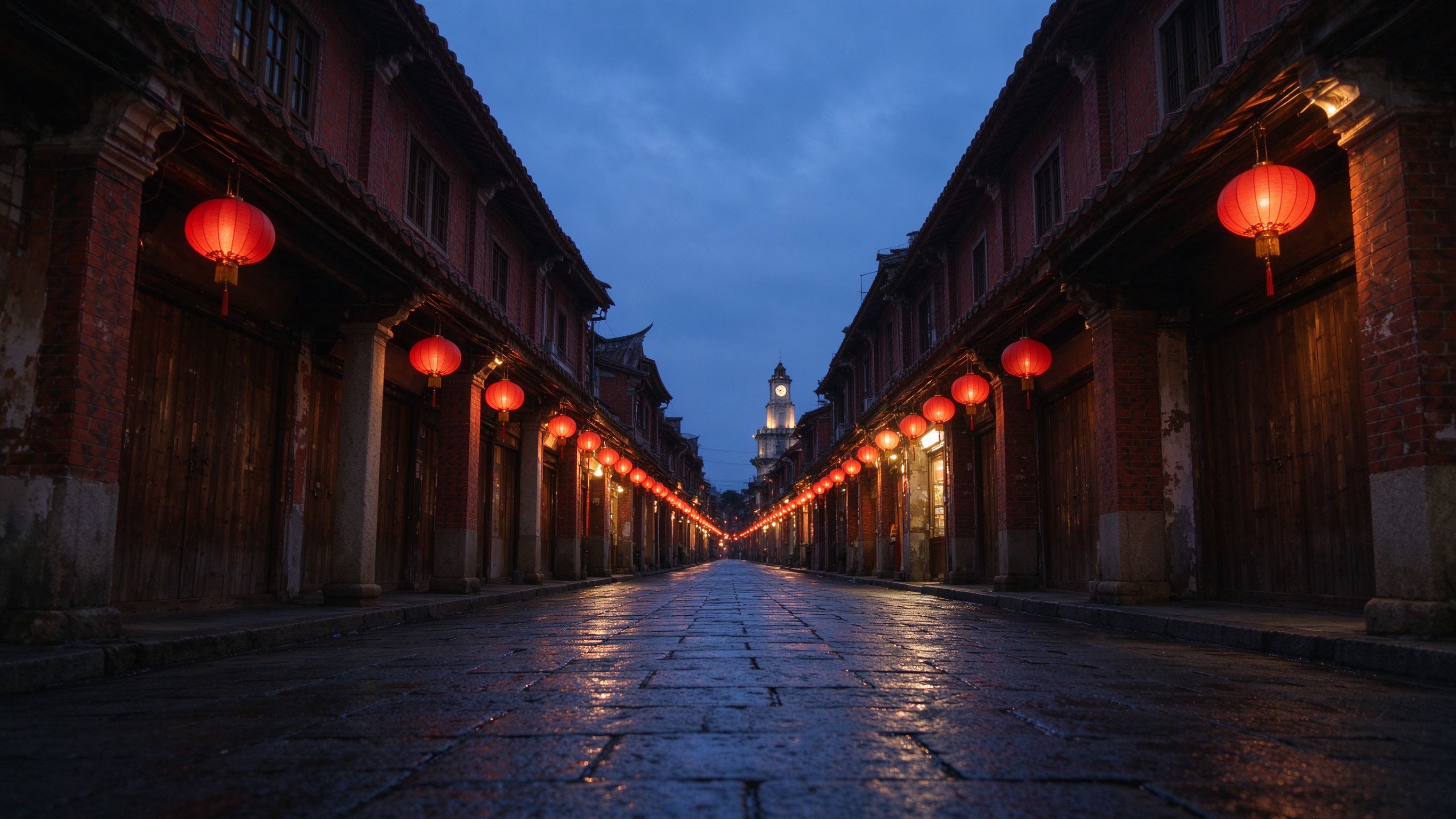
Walk out onto West Street, the spine of the old town, and head north toward the Bell Tower. This is where Quanzhou eats, argues, sells tourist trinkets and queues for fried dough at eight in the morning. The side lanes matter more than the main street: turn off for any alley that looks too narrow for a car and you will find red-brick courtyards, family shrines and people shelling oysters on their doorstep.
The Confucius Temple, or Fu Wen Miao, dates to 976 and is the largest Confucian building complex in southeast China. It is free, open 9:00 to 17:00, and closed on Mondays. The courtyard is usually empty in the late afternoon, which makes it the best place in the city to sit down for twenty minutes.
Two minutes away, the Qingjing Mosque is a different century and a different world. Built in 1009, it is one of the oldest mosques in China, and the surviving stone gateway is the original structure — worn smooth by a thousand years of hands. Entry is 3 yuan. Hours run 09:00 to 17:15 from November to April and 09:00 to 17:45 from May to October. This is an active place of worship: cover shoulders and knees, keep your voice down, and do not walk in front of anyone praying.
Continue south to the Tianhou Gong, the Mazu temple founded in 1196 and the oldest and best preserved of its kind in China. It is free, open 7:00 to 17:00, and still busy with worshippers rather than tourists. The smell of incense here is not staged.
Just outside, the Deji Gate site preserves the foundations of the city wall from 1230, and a few minutes further on lies the Maritime Trade Office site — the customs house established in 1087, and the only surviving ancient customs building complex in China. Both are free, open-air, and easy to miss because there is no ticket booth and no queue. That is rather the point of Quanzhou.
If you have energy left, the Zhenwu Temple and the Nannwai Zongzheng Si site round out the old-city circuit. Save the Laojun rock carving — 5.63 metres of stone Laozi — for Qingyuan Mountain, which charges 70 yuan and deserves its own morning.
A two-day route that actually works
Day one belongs to the old town. Kaiyuan at 7:00, West Street and the side lanes until 9:30, the Confucius Temple at 10:00, Qingjing Mosque at 11:00, lunch around Tumen Street, Tianhou Gong and the Deji Gate in the early afternoon, then a slow coffee and a rest. Go back out at 16:30 when the light turns gold and the shopkeepers start closing: the Bell Tower, the arcades, the wet stone. Eat dinner late; Quanzhou is a night-market town.
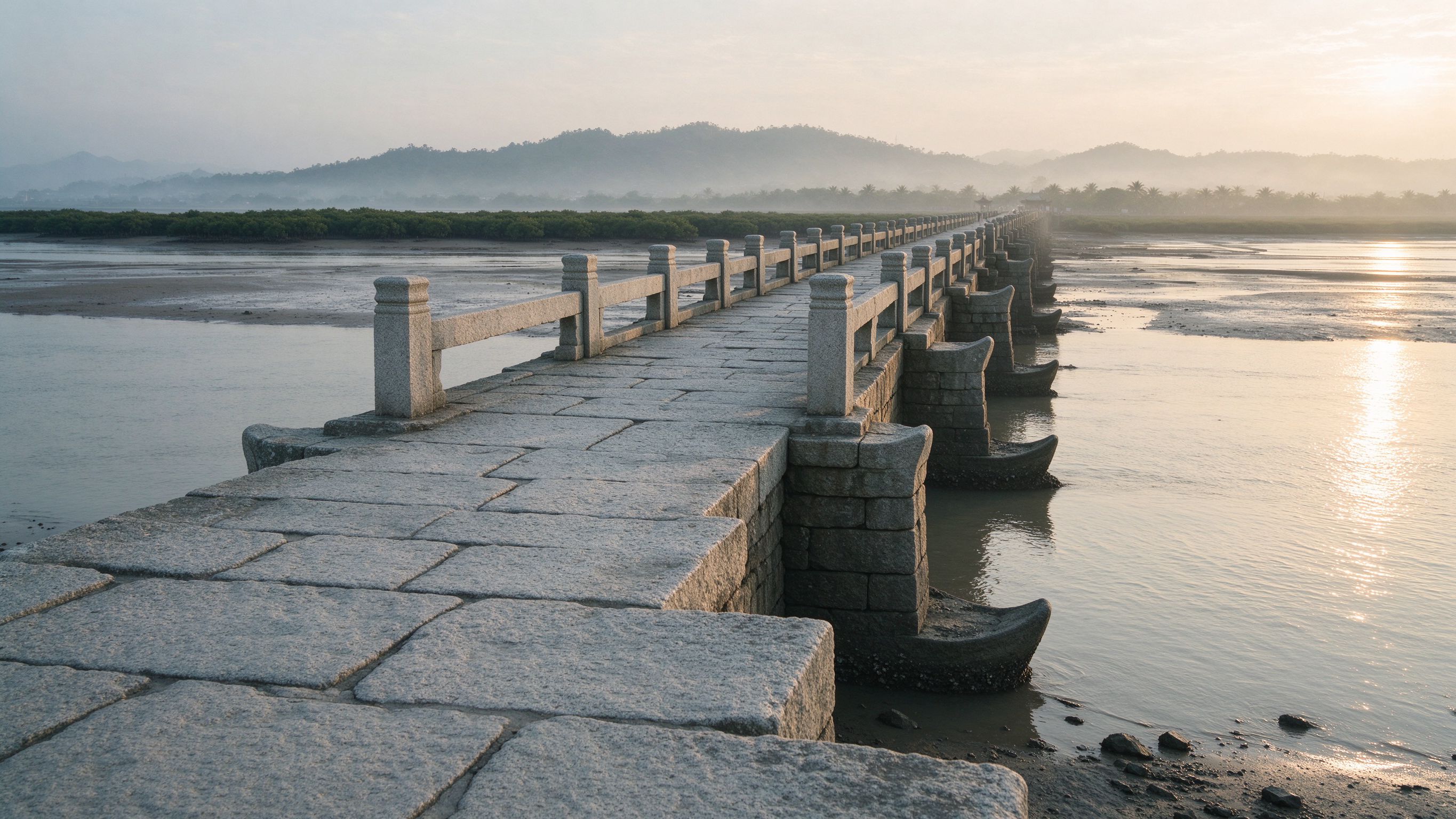
Day two starts early at Luoyang Bridge, 20 minutes north of the old town. Built in 1053, it is one of China's four great ancient bridges, and it is free and open around the clock. The trick is to arrive before 7:30, when the tide is low and the stone piers sit in mudflats with egrets picking through them. There is no ticket gate, no visitor centre, just a bridge that local people still cross on scooters.
Come back into the city, and spend the middle of the day at Xunpu. Late afternoon is also good there: the light softens, the tour buses leave and the seawall turns pink. Then take a taxi up to Zhenwu Temple for sunset over the harbour, or stay at Xunpu for the fishing boats coming in.
A third day, if you have one, should go outside the city. Qingyuan Mountain in the morning for the Laojun carving and the city view; Jiuri Mountain, where the Song dynasty carved prayers for safe voyages into the rock between 1174 and 1266; Anping Bridge in Jinjiang, built in 1152, 2.5 kilometres long and still the longest ancient beam bridge in China; or the Cao'an Manichaean statue from 1339, the only stone Manichaean figure in the world. Dehua's porcelain kilns and Anxi's tea mountains are each about 90 minutes away and worth a full day of their own.
Xunpu: oyster walls, flower crowns, and a village that is not a theme park
Xunpu sits about 7 to 10 kilometres east of the old town, on the north bank of the Jinjiang estuary. It is free, needs no reservation, and is open all day; the flower shops generally run from 08:30 to 18:30.
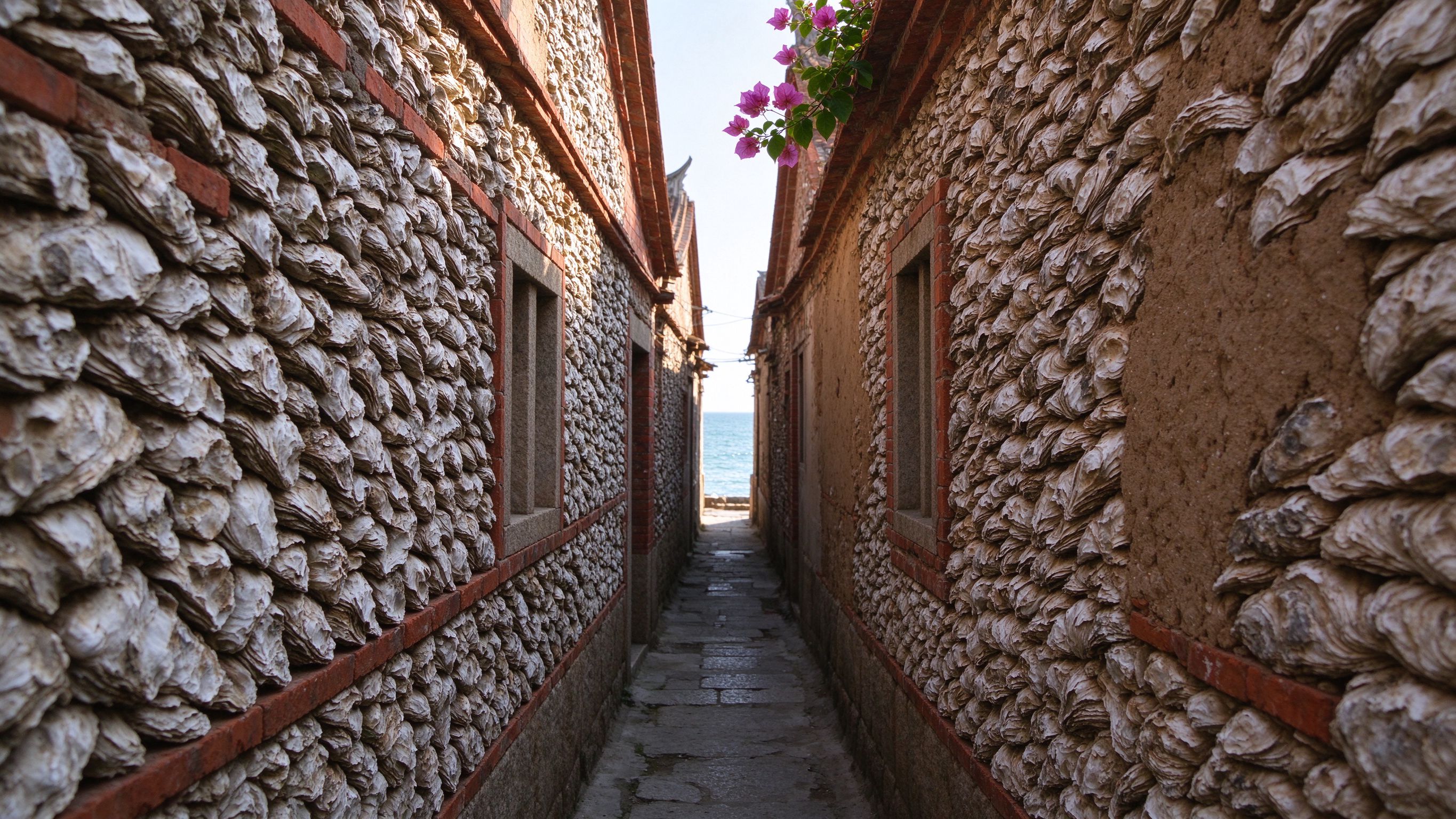
Two things made it famous. The first is the oyster-shell houses, known locally as keqiaocuo. The large oyster shells in the walls are not local: they were carried back as ballast by ocean-going merchant ships in the Song and Yuan periods, then mortared into walls with red brick and rammed earth. The result is a wall that resists salt air, sheds water and stays cool in summer — and looks, up close, like something between fish scales and a coral reef.
The second is the flower crown, or zanhuawei. Women in the village have worn fresh jasmine, gardenia and chrysanthemum pinned around a bun for centuries, and the custom — known formally as the Xunpu women's custom — was added to the second batch of the national intangible cultural heritage list in 2008. It is not a costume invented for tourists, although the version you will be handed at a shop is a modern, simplified one.
Practically: bus 8 from Wenmiao, next to the Confucius Temple, runs to the village in 25 to 35 minutes for 2 yuan; K301 takes about the same and costs 3 yuan. A taxi from the old town is 20 to 30 yuan. Tell the driver "Xunpu miao" — the Mazu temple — because that is the landmark everyone knows. A basic flower crown with costume rental starts around 40 yuan at most shops; studio packages with make-up and a photographer run 150 to 300 yuan. Ask what is included before you sit down.
The village received more than 8.5 million visitors in 2024 and 4.26 million in the first seven months of 2025, according to People's Daily, and there are now close to 300 photo studios. That number tells you what to expect on a Saturday at noon: queues, tripods, and a lot of people in the same blue tunic. Go before 10:00 or after 16:00, and go on a weekday if you can. Walk past the studio strip to the older lanes near the seawall, where the houses are still houses and the alleys still smell of drying fish.
One etiquette note: many of the older women in flower crowns are residents, not models. Ask before photographing them. A smile and a gesture at your camera is usually enough, and a small tip of 10 or 20 yuan is appreciated if you take several frames.
What to eat, and what it costs
Quanzhou food is Fujian food without the hotel-lobby polish: sour, savoury, seafood-heavy and cheap.
- Mianxianhu, a thick rice-flour soup with oyster, pork intestine, mushroom and a sprinkle of white pepper. A bowl is 10 to 20 yuan and is what locals eat at 7 am.
- Niurougeng, a beef soup thickened until it is almost a custard, usually served alongside rice.
- Jiangmuya, ginger duck, braised until the ginger turns sweet. A half duck feeds two and costs roughly 60 to 90 yuan in the older restaurants.
- Haijian, oyster omelette, 20 to 30 yuan a plate, best from the stalls near Tianhou Gong.
- Tusundong, the notorious "earthworm jelly" — actually made from a kind of sipunculid worm found in the mudflats. It is chilled, translucent and tastes of the sea. 10 to 20 yuan. Try it once.
- Sigutang, a bowl of shaved ice with four toppings, 8 to 15 yuan, and the correct response to a 33-degree afternoon.
- Runbing, a thin wrapped roll of vegetables and seaweed, and pork zongzi, sticky rice in bamboo leaves, both under 15 yuan.
Eat on the side streets off West Street and around Tumen Street, where the signs are faded and the queues are local. A full day of eating here rarely passes 150 yuan.
Practical notes that save you a wasted afternoon
- Carry 200 to 300 yuan in cash. Most places take Alipay and WeChat Pay, but older shops, temples and small stalls still prefer notes, and foreign cards fail more often than you expect.
- Set up Alipay or WeChat Pay before you land, with your home card attached. It works in most shops, but not all, and not always on the first try.
- Temple dress code is real. No vests, no shorts above the knee, no flip-flops in Kaiyuan, Qingjing or Tianhou Gong. Carry a light scarf.
- Monday closes the Confucius Temple, the Fujian-Taiwan Kinship Museum and the intangible heritage museum. The latter needs a reservation and runs Tuesday to Sunday, 9:00 to 17:00.
- The Qingyuan Mountain ticket is 70 yuan; a shuttle inside is 15 yuan. Chongwu Ancient City, on the coast, is 40 yuan. Jiuri Mountain is free, 8:00 to 17:30 in winter. Six Victory Pagoda is 5 yuan.
- English signage is scarce outside the main sites. Save addresses in Chinese, and use a translation app for taxi drivers.
- Check the tide before any coastal stop. Luoyang Bridge and the Xunpu seawall are best at low tide, and the difference is two hours of walking on mud versus water.
- July to September is hot, humid and typhoon season. October to April is the window: dry, 18 to 26 degrees, and clear enough to see the hills across the bay.
When to go, and what two days cost
October through April is the sweet spot; November in particular is dry and mild, which is why the city fills up on weekends. Avoid the first week of October and the first three days of Lunar New Year, when half the restaurants close and the flower shops run out of fresh stock.
A realistic two-day budget per person, excluding travel to Fujian: 200 to 400 yuan a night for a guesthouse, 120 to 250 yuan a day for food, 0 to 80 yuan for tickets if you skip Qingyuan Mountain, and 30 to 60 yuan for local transport. Call it 600 to 1,000 yuan for two days, which is roughly what a single night in a Shanghai hotel costs.
Quanzhou rewards the traveller who slows down. The city has 945 protected heritage sites, 44 of them national-level, and no plausible way to see them in a weekend. Pick the old town, one bridge, one village, and leave the rest for the next trip. For more ideas on where to go next, browse our experience collections, or read our guide to Shenzhen's Nantou old town if you want another historic quarter that survived the developers. If you are travelling in the colder months, our winter travel notes cover what changes in November and December.
Who this is for
Independent travellers based in Xiamen or Fujian who want a historic Chinese city with real street life, low ticket prices and no tour-bus circuit.
How to do it
Book a high-speed train to Quanzhou station rather than Quanzhou South if you are heading straight to the old town; the ride from Xiamen North is 26 to 33 minutes.
Stay near West Street so you can reach Kaiyuan Temple at 7:00, before the tour groups.
Walk the old-town loop: Kaiyuan Temple, West Street, the Confucius Temple, Qingjing Mosque, Tianhou Gong and the Deji Gate, allowing a full day with breaks.
Give day two to Luoyang Bridge at low tide before 07:30, then Xunpu village in the late afternoon for the flower crowns and oyster-shell lanes.
Carry 200 to 300 yuan in cash, set up Alipay or WeChat Pay before arrival, and dress for active temples.
Watch for
Treating Quanzhou as a day trip from Xiamen: you will see the temple and leave before the old town wakes up at dusk.
Trying to cover all 22 World Heritage sites in two days; Dehua, Anxi and the Jinjiang bridges are each an hour or more away.
Arriving at Xunpu at noon on a weekend, when the photo-studio strip is at its most crowded.
Wearing shorts, vests or flip-flops into Kaiyuan Temple, Qingjing Mosque or Tianhou Gong.
Assuming foreign bank cards work everywhere, or that there is a metro.
What may vary
Opening hours, ticket prices and train timetables change seasonally. Kaiyuan Temple's clearing time is listed as both 17:00 and 17:40 by local sources; confirm on arrival. Xunpu flower-crown prices vary by shop and season.
Backup plan
If Luoyang Bridge is crowded or the tide is wrong, swap it for Anping Bridge in Jinjiang (free, 2.5 km long) or the Jiuri Mountain prayer inscriptions, both quieter and equally historic.
FAQ
How do I get to Quanzhou from Xiamen?
High-speed trains from Xiamen North reach Quanzhou South in 17 to 19 minutes for about 25 to 32 yuan; Xiamen station to Quanzhou takes 43 to 57 minutes. Quanzhou station is closer to the old town than Quanzhou South.
How much are tickets in Quanzhou?
Kaiyuan Temple, the Confucius Temple, Tianhou Gong, Luoyang Bridge and Xunpu are free. Qingjing Mosque is 3 yuan, Qingyuan Mountain 70 yuan, Chongwu Ancient City 40 yuan and Six Victory Pagoda 5 yuan.
Is Quanzhou worth two days?
Yes. One day covers the old town; the second adds Luoyang Bridge at low tide and Xunpu village. A third day allows Qingyuan Mountain, the Jinjiang bridges or the Dehua and Anxi kilns.
When should I avoid Quanzhou?
Avoid the first week of October and the first three days of Lunar New Year, when restaurants close and Xunpu's flower shops run short of fresh stock. July to September is hot, humid and typhoon season.